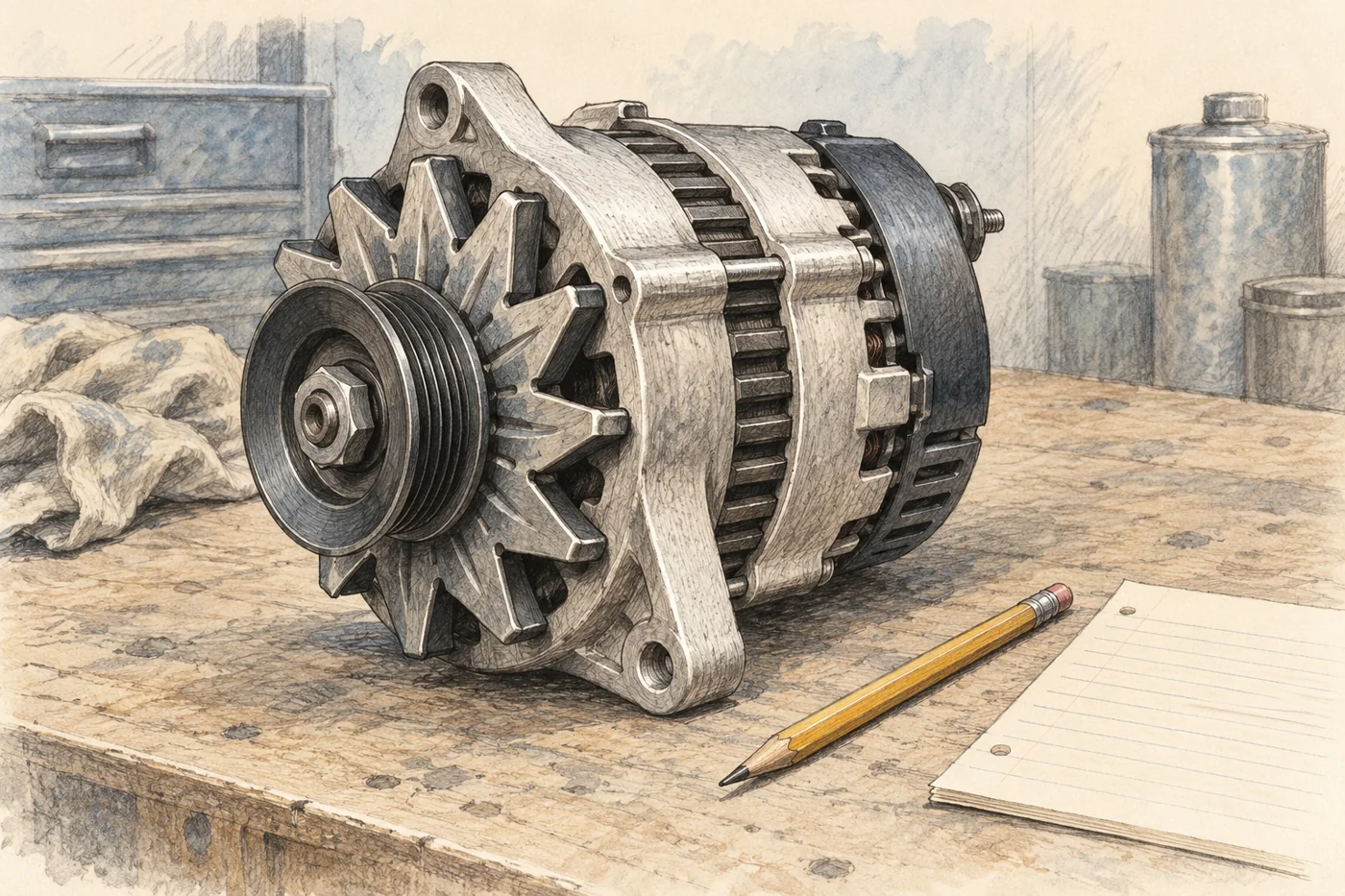
The first puzzle on the generator specification page is a stack of three numbers: 1102394, 1102491 and 1102889. They appear together in the 1979 Chevrolet light-truck service manual, inside one ruled group. Look across the page and there is just one Delco Remy specification number for that group, 4519, and one shared rated-hot-output figure.
Why list three model numbers against those shared figures? The answer waits below the table. Chevrolet explains that, within each group, the generators differ only in the rotational position of the end frame. A small note gives the list of numbers a more useful shape: the manual is distinguishing an orientation, even where it prints the same electrical specifications.
Follow the table downward and the pattern continues. Another group holds three model numbers, the next holds four, and the last holds two. Each group has its own specification number and output figures. The note belongs to the generators within each group; it does not erase the differences between groups.
For a restorer tracing a number, there is another detail worth keeping in view. The application descriptions occupy a shared space beside each list of model numbers. The printed layout does not give every model number its own separate application row. Reading straight across from one number to the nearest line of text can promise a match the page has not actually made.
That leaves a useful, manageable answer. This 1979 page explains why several generator numbers can sit together under shared specifications, and it identifies end-frame position as the distinction within those groups. To establish which numbered unit belongs on a particular truck, keep looking for evidence that makes that individual connection. The rotation note is a clue to follow, not a modern replacement-parts interchange guide.
Source: Chevrolet, 1979 Light Duty Truck (Series 10–35) Chassis Service Manual, ST 330-79, printed page 6D-53, chart 6D-S1, “Engine Electrical / Specifications / Generator,” PDF page 788.
Scope note: The page is used within its 1979 manual context; it does not establish an independently dated leaf revision, individual model-to-application pairing, or the unit installed on a surviving truck.
Related reading: 1979 Chevrolet 305: three distributor numbers, four application branches follows a separate chart in the same 1979 manual. Its Federal application branches are identification evidence, not a modern replacement-parts interchange guide.