RareTruckInfo is a transparent, evidence-based research archive. Important claims should be traceable to the documents, photographs, publications, vehicle records, or other sources that support them.
Sources We Use
- Factory literature, parts catalogs, service publications, dealer materials, and period advertising
- Build sheets, SPID labels, certification labels, invoices, titles, and other original vehicle records
- Photographs and physical examination of surviving vehicles
- Government records, newspapers, trade publications, auction archives, and contemporary reporting
- Owner documentation, recollections, online discussions, and sales listings used as leads and clearly identified when unverified
Research with Source Notes
See the 1976 pickup powertrain guide for combinations drawn from Chevrolet’s January 1976 data book, the RPO and option guide for selected code findings, and the C10 in Japan research note for an example of a survivor lead with stated limits. The sample owner report shows how vehicle records and unresolved claims are presented.
Related-year source notes: compare the 1979 and 1980 Chevrolet regular-cab two-tone charts, the 1985 Outdoorsman sales offer, and the 1987 R/V–1988 C/K identification references. Each note retains its own document dates, model limits and unresolved questions.
Selected 1976 factory sources
General Motors truck VIN card
General Motors, 1976 General Motors Truck VIN System, truck chart, PDF page 2; imprint 10/75. Read the GM-hosted card.
The chart identifies the VIN positions for division, chassis type, engine, nominal ton rating, body type, model year, assembly plant and production sequence. It covers several truck types. Use its codes with the vehicle’s own labels and documents; a matching VIN pattern does not establish original equipment or a special-edition package.
Chevrolet pickup model, trim and paint references
Chevrolet Motor Division, 1976 Chevrolet Truck information kit, hosted by GM Heritage. Read the pickup model selector: printed Pickup Page 1, January 16, 1976. It separates regular-cab, Bonus Cab and Crew Cab models, box lengths and body-ordering codes.
Regular-cab interior/exterior chart: printed Pickup Page 12, August 29, 1975. Exterior paint layouts: printed Pickup Page 14, January 16, 1976. Keep the different dates and body-style limits with each citation. These general Chevrolet references require separate VIN-linked evidence before assigning equipment, trim or paint to a surviving truck.
Chevrolet Suburban model and equipment references
Chevrolet Motor Division, 1976 Chevrolet Suburban information kit, hosted by GM Heritage. Model selector, printed/PDF page 1, January 16, 1976, distinguishes C10, C20, K10 and K20 model numbers and rear-closure codes. Trim hierarchy, page 3, August 29, 1975, describes Scottsdale Z62 and Silverado YE9. The same kit contains rear-door and seating diagrams, a color/trim chart and the priced options cited in our RPO guide. Keep each page’s date and Suburban applicability with its claims; a general option listing does not prove equipment on a particular vehicle.
Sources visually checked September 30, 2026. Links point to the source hosts; no source scans are reproduced here.
Additional dated references
These selected source passages were independently checked October 2–3, 2026. Links point to source hosts; no source scans are reproduced here.
California certification records
California certification records provide another dated check on listed configurations. Order A-6-64R, executed August 26, 1975, covers specified 1976 Chevrolet and GMC 350-cu.-in. light trucks with three-speed automatic transmission, engine family 12J4. Its initial December 31, 1975 build-date limit must be read with A-6-74, issued in December 1975, which extended listed approvals through the remaining 1976 model-year production subject to stated conditions. A-6-64R-1, executed February 20, 1976, separately certifies listed three-speed-manual applications and says its certification is valid for the full model year. These are California certification records for specified models; they do not establish nationwide availability, a production-change date, or a surviving truck’s original equipment.
Sources: CARB A-6-64R, August 26, 1975, PDF pages 1–2; A-6-74, December 1975, PDF page 1; A-6-64R-1, February 20, 1976, PDF pages 1–2.
1976 C/K wiring extract
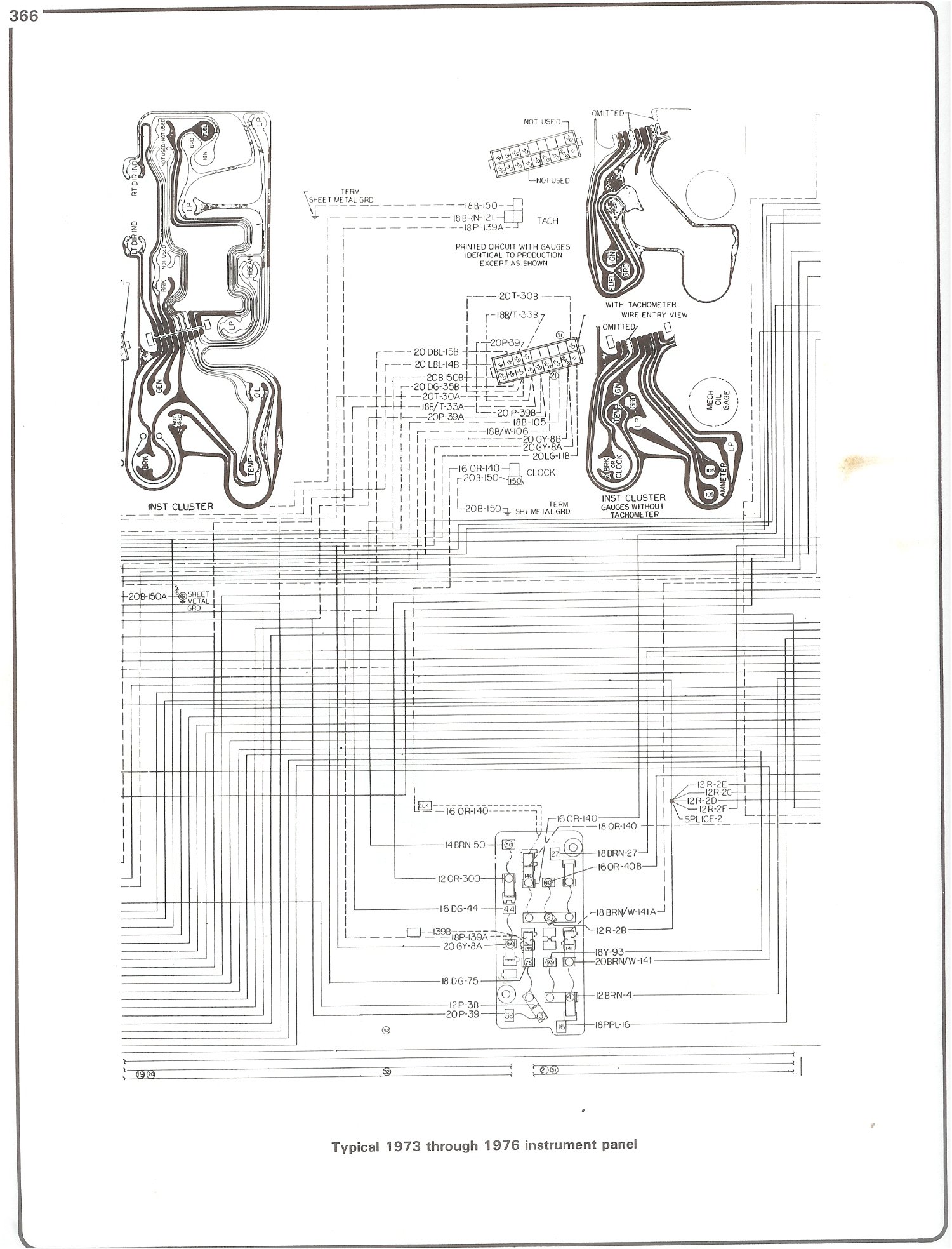
For 1976 C/K wiring, use GM’s X-7630 / ST-352-76 extract: its cover and A-4724 Sheets 1–4 form a five-page C/K selection, rather than the complete all-model publication. Sheet 1 identifies a voltmeter in the gauged instrument cluster, consistent with the 1976 service supplement’s stated replacement of the ammeter. A separately circulated sheet captioned for 1973–76 depicts an ammeter, so that pooled-year drawing should not be used as exact 1976 charging-gauge evidence. This discrepancy does not establish that every circuit on the pooled drawing is wrong.
Sources: GM 1976 Truck Wiring Diagrams, X-7630 / ST-352-76, cover and A-4724 Sheets 1–4; Chevrolet ST-330-76, printed 12-6 / PDF 244; pooled 1973–76 instrument drawing, visible 366 (original publisher and date not established).
Chevrolet cargo-van configuration
The Chevrolet cargo-van model selector dated January 16, 1976 lists 110-inch-wheelbase models CG11005, CG21005 and CG31005, and 125-inch models CG11305, CG21305 and CG31305 for G10, G20 and G30 respectively; ZW9 is the body-ordering entry throughout. Printed page 3, dated August 29, 1975, separately describes Z61 Custom Appearance and Z62 Custom Comfort and Convenience equipment. Printed page 5 illustrates standard one-front-seat and optional two-front-seat arrangements. These cargo-van pages should be cited by their actual headings rather than assigned to Beauville passenger-van material.
Source: Chevrolet Motor Division, 1976 Chevrolet G-Van information kit: model selector, printed 1 / PDF 2, January 16, 1976; custom options, printed 3 / PDF 4, August 29, 1975; Seating and Loadspace, printed 5 / PDF 6.
1976 GMC van names and body codes
GMC’s U.S. brochures distinguish the commercial Vandura from the passenger-carrying Rally Wagon and Rally STX. Commercial Trucks describes a standard driver’s seat with an available companion seat in the Vandura. Recreation Vehicles describes front seats and the first three-passenger rear seat as standard in Rally models, with seating for up to twelve in selected models. The brochure names describe different offerings; a surviving van’s installed seats do not establish its factory model.
Sources: GMC Truck & Coach Division, Commercial Trucks, printed 2–3 / PDF 2, ADV. 76-7 (8-75); Recreation Vehicles, printed 7 / PDF 4, ADV. 76-2 (8-75). Both are U.S. publications.
The 1976 service supplement’s model-number table explicitly includes Chevrolet and GMC. It defines chassis letter G as integral-body/frame forward-control 4×2, model-number body-style ending 05 as Chevy Van/Vandura, and ending 06 as Suburban/Sportvan/Rally Wagon with panel rear doors. Its separate body-ordering entry E94 identifies Beauville Sportvan/Rally STX. These are model and ordering definitions, not proof of the model or options installed on an individual van.
The VIN uses a separate code structure. In the service supplement’s VIN figure, the fifth character 5 means Van and Panel; the October 1975 GM truck VIN card shortens that description to Panel. The VIN’s fourth character is the nominal ton rating, where 2 means three-quarter ton. Do not substitute the VIN’s single body character for the model number’s two-digit body-style ending, or use it alone to establish Rally/STX identity.
Sources: Chevrolet Motor Division, 1976 Chevrolet Light Truck Service and Overhaul Supplement, ST-330-76, printed 0-2 / PDF 8, Truck Model Identification, and printed 0-3 / PDF 9, Figure 2; General Motors, 1976 General Motors Truck VIN System, PDF 2, 10/75 imprint. The preserved service-supplement originals were inspected.
Windows also require care. GMC offered Vandura window combinations extending to all-around glazing, while its recreation brochure described conversion components from other manufacturers and local businesses. Its commercial brochure separately identifies raised-roof Vanduras modified by commercial companies. Present windows, seats or a raised roof therefore need supporting vehicle-specific documents before they can establish original equipment or a conversion builder.
Sources: Commercial Trucks, printed 4 / PDF 3, window combinations and printed 2 / PDF 2, raised-roof caption; Recreation Vehicles, printed 7 / PDF 4, Vandura/Rally text.
Canadian literature has its own scope. GM-4704 describes Vandura and its window choices. GM-4705 separately names Rally Wagon and Rally STX: the standard seating arrangement accommodates five, a second full-width rear seat brings capacity to eight, and the third rear seat is optional only on one-ton units for accommodation up to twelve. Both brochures identify General Motors of Canada and carry Printed in Canada imprints without a month/date on the inspected back covers. These Canadian descriptions do not supply a U.S. ordering matrix or authenticate seats in a survivor.
Sources: General Motors of Canada Limited, 1976 GMC Vandura, Magnavan and Value Van, printed 5 / PDF 3, GM-4704, imprint on PDF 5; 1976 GMC Jimmy, Suburban and Rally Wagon, printed/PDF 6–7, GM-4705, imprint on PDF 8. These previously archived sources were rechecked for the selected model and seating descriptions.
The same GMC model designation could appear with different body construction. In GMC’s U.S. 1976 Commercial Trucks brochure, TG/31603 appears under both STEEL and ALUMINUM in the MagnaVan dimensions table; each entry has a 146-inch wheelbase. Keep the slash as printed when citing this table. The designation and wheelbase alone therefore do not distinguish those two body materials.
The Canadian 1976 Vandura, Magnavan and Value Van brochure separately describes a 146-inch-wheelbase Magnavan with dual rear wheels, without giving a full model code in that passage. This is Canadian brochure context, not a reason to apply the U.S. model table as Canadian ordering instructions.
Sources: GMC Truck & Coach Division, 1976 Commercial Trucks, printed 7 / PDF 4, “GMC Magnavan Technical Data”, ADV. 76-7 (8-75), U.S. imprint on PDF 5; General Motors of Canada Limited, 1976 Vandura, Magnavan and Value Van, printed 4 / PDF 3, GM-4704. The Canadian brochure’s back cover / PDF 5 has no visible print month or date.
GMC model-scoped engine references
GMC’s U.S. brochures for 1976, printed in August 1975, keep engine coverage model-specific. Commercial Trucks lists a 400 four-barrel V8 for the Vandura/MagnaVan 6,001-lb-GVW-and-above group. People Movers restricts its Suburban 400 entry to K-model four-wheel drive, yet separately lists a Rally 400 in the 6,001-lb-and-above group. These tables do not create a GMC-wide four-wheel-drive-only rule or a complete pickup ordering matrix.
Sources: GMC Truck & Coach Division, Commercial Trucks, ADV. 76-7 (8-75), printed 5 / PDF 3; U.S. imprint on unnumbered back cover / PDF 5. People Movers: Suburban and Rally, ADV. 76-4 (8-75), printed 6 / PDF 4, Suburban 400 footnote and unnumbered back cover / PDF 5, separate Rally table and U.S. imprint.
1976 fuel-economy label formats
The 1976 EPA/FEA program distinguished general fuel-economy labels, using sales-weighted estimates for a model grouping, from labels for a specific configuration, including weight and axle-ratio distinctions. Both sample formats carried an optional-equipment caveat, so that sentence alone does not identify the label type. A surviving sheet’s appearance and model description may be consistent with a format without authenticating its approval history, original installation or a VIN-specific test.
The March 1976 rule required labels for the 1976-model-year passenger cars and light trucks covered by the earlier program and manufactured in or imported into the United States after March 20, 1976, effective March 21. The earlier voluntary-program description therefore does not describe the requirements for the entire model year.
Sources: EPA/FEA, “Voluntary Fuel Economy Labeling—Program for 1976 Model Automobiles,” June 20, 1975, 40 FR 26059–26060 / PDF 55–56, definitions and sample labels. EPA, “Fuel Economy Labeling Regulations for 1976 Model Year Automobiles,” March 19, 1976, 41 FR 11506 / PDF 54, coverage and effective-date transition; incorporated Attachment B, 41 FR 11512–11513 / PDF 60–61, formats and sample labels.
1976 Chevrolet body and frame references
Chevrolet’s 1976 C/K supplement documents a hood-lock assembly modification associated with the new radiator grille. Its Figure 1, “Hood Lock Catch and Support—CK Series,” illustrates the 1976 assembly. A visual match alone does not establish original installation.
Source: Chevrolet Motor Division, 1976 Chevrolet Light Truck Service and Overhaul Supplement, ST-330-76, Section 11 opening, indexed as 11-1 / PDF 237, “Hood Lock Assembly” and Figure 1.
Chevrolet’s U.S. 1976 pickup brochure, printed in September 1975, describes an all-steel ladder frame with a drop center for lower cab mounting and deep-section channel side rails. This brochure description does not identify an individual frame’s plant or date, or establish its original installation in a surviving truck.
Source: Chevrolet Motor Division, 1976 Chevy Pickups, form 3321, September 1975, printed 7, “Tough steel frame,” on the 6–7 spread. The cover prints “’76”; the unnumbered back cover / archive scan 12 carries “Sept., 1975,” form 3321 and the U.S. printing statement.
Body finishes, glass and interior identification
Use the cab, body and document date when comparing parts on a surviving truck. The following descriptions apply to Chevrolet pickups; GMC, Blazer and Suburban applications require their own sources. The paint and upholstery reference supplies the separate layout and trim charts.
Chevrolet’s January 16, 1976 paint sheet specifies white raised tailgate lettering, changing to black with Frost White. The determining color is the body color for ZY1, primary color for ZY2, and secondary color for ZY3/ZY4. Cheyenne/Silverado Fleetside bright trim plates cover that lettering. The August 29, 1975 E62 Stepside description specifies kiln-dried, sealed wood flooring but gives no wood species, coating formula or floor-paint color. The September 1975 U.S. brochure separately describes primer treatments on metal panels. Those production descriptions provide historical material evidence, without supplying a present repair or refinishing procedure.
Sources: Chevrolet Motor Division, 1976 Chevrolet Truck, Pickup 14 / PDF 17, January 16, 1976 and Pickup 9 / PDF 12, August 29, 1975; 1976 Chevy Pickups, form 3321, September 1975, printed 7, rust-protection paragraph and diagram.
The August 29, 1975 pickup cab description specifies a laminated windshield, solid safety-glass rear window and front-door ventipanes. The C10 and K10 ordering leaves revised March 26, 1976 list A01 Soft-Ray tint for all windows and A28 sliding rear window; their U63/U69 radio entries include U76 windshield antenna. A pane’s DOT manufacturer code answers another question: the June 1975 federal list assigns 15 to Libbey-Owens-Ford, 18 to P.P.G. Industries and 19 to Duplate Canada. These entries identify glazing manufacturers; they do not date the glass or identify its original vehicle installation.
Sources: 1976 Chevrolet Truck, Pickup 6 / PDF 9, August 29, 1975; 1976 Dealer Order Guide, C10 Pickup printed/PDF 6 and K10 Pickup printed/PDF 34, both revised March 26, 1976 (preserved original inspected; no verified public scan URL); NHTSA, “Prime Glazing Material Manufacturers,” issued June 10, 1975, Federal Register June 16, printed 25503 / PDF 85.
The January 16, 1976 Custom Deluxe standard-equipment page describes molded-plastic door panels with integral armrests, front outboard lap/shoulder belts and a separate center lap belt; its rear-belt description is explicitly for Crew Cabs. On the August 29, 1975 trim page, Scottsdale’s woodgrain door inserts and bright door-panel trim are limited to Regular Cabs. The separate Regular Cab Cheyenne description includes secondary seals on the upper door frames. These are dated equipment descriptions, not authentication of surviving trim or belts.
Sources: 1976 Chevrolet Truck, Pickup 2 / PDF 5, January 16, 1976 and Pickup 3 / PDF 6, August 29, 1975.
Later service data must retain its date: Catalog 51’s February 1983 windshield listings distinguish clear/tinted and antenna/no-antenna replacements, without establishing a 1976 production part number. Supplier-specific glass and belt date-code legends remain unresolved. Blue/White trim, NDW1 and matching door-panel appearance alone do not establish Spirit of ’76 identity or exclusivity.
Source: General Motors, Truck Parts Catalog 51, REV. 2-83, printed 16-1 / preserved PDF 1103, group 16.005. The selected original page was inspected; no verified public scan URL is available. The unresolved Spirit/NDW1 distinction is documented in the paint and upholstery reference.
Retrospective lamp-socket identification
GM service-catalog leaves revised in February 1983 link side-marker socket assembly 6298886 to the number 6294015 on the grip for listed 1973–78 C/K, Blazer and Jimmy applications. The note describes a round base, lock tabs and black-and-brown cables. This separates a grip marking from an assembly reference; it does not establish a 1976 production date, supplier, original installation or present replacement compatibility.
Source: General Motors, Truck Parts Catalog 51, leaves marked REV. 2-83: printed 2-47 / preserved PDF 303, group 2.596 Note 3; printed 2-48 / PDF 304, side-marker socket assembly row; and printed 2-52 / PDF 308, group 2.714. These three specific GMPartsWiki pages and original images were accessed and visually checked October 22, 2026. The generated OCR on page 55056 misreads 6298886 as 8298886; the printed image controls. The printed 2-47 “molding” and 2-52 “stamped” wording differ, so “number on the grip” is used above.
Historical EPA test records
A historical test report can document a truck during its working life while leaving its present survival unknown. Automotive Testing Laboratories’ A Study of Emissions From 1975–1979 Light-Duty Trucks, prepared for EPA in March 1980 (EPA-460/3-80-008), includes records for 1976 trucks.
For example, the St. Louis table identifies vehicle 6255 as a 1976 Chevrolet C10, VIN CCV146S166214. Its test table records LOWT and BASE runs on March 1, 1979. These are two test stages for one vehicle under different prescribed conditions; they do not establish a before-and-after repair comparison. Match entries across appendices by city, vehicle number, year, make and reported model. A study number alone is insufficient, and the test city does not identify the assembly plant.
The report supplies historical observations, without establishing original factory equipment, present survival, current custody or present roadworthiness. These entries are not counted as documented surviving trucks.
Selected sources: VIN table, C-37 / PDF 275; test stages and dates, A-108 / PDF 184; test-stage definitions, A-ii / PDF 76. Preserved original pages reviewed October 3, 2026.
Research Statuses
Each status applies to a specific claim—not to the owner, contributor, or truck as a whole.
- Verified: reliable evidence directly and consistently supports the claim, with no material unresolved conflict.
- Probable: the evidence strongly supports the claim, but a decisive record is missing or a meaningful limitation remains.
- Unverified: the claim may be plausible or widely repeated, but there is not enough reliable evidence to support it.
- Incorrect: reliable evidence contradicts the claim.
- Superseded: an earlier finding has been replaced by stronger or newer evidence, while the previous conclusion remains in the revision history.
- Not Assessable: the available material cannot answer the question because it is missing, unreadable, or inconclusive.
Read the complete evidence hierarchy, privacy safeguards, and revision policy in How RareTruckInfo Research Works.
Citation Standard
Citations should identify the title, creator or publisher, date, page or document number when available, exact web address, and access date. Vehicle-based evidence should identify what was actually visible—such as a VIN, SPID label, build sheet, trim code, or dated photograph—without claiming more than the evidence proves.
1983 C/K pickup: conflicting dated factory pages
A correct transcription does not automatically resolve a truck’s year-wide availability. Different dated leaves in the same factory compilation can disagree.
Two examples appear in GM’s first 1983 C/K pickup section:
- E62 Stepside/Fenderside bodies: the September 1982 selector limits the starred C10/1500 and K10/1500 entries to C/K10703. February 1983 Page M nevertheless includes C10903 and K10903 in its E62 group with a 98.3-inch inside body length. [1] [2]
- ZY9 colors: September 1982 Page Q describes nine combinations for Fleetside/Wideside pickups with dual rear wheels. February 1983 Page N has eleven special-package color-pair rows, with only one expressly marked N/A ZY9, leaving ten without that exclusion. [3] [4]
These differences remain unresolved. Neither comparison proves a midyear expansion, an error, a superseding revision or an effective change date. A dimensional reference is not proof that a specific order was accepted or a truck was built.
Keep each leaf’s date, model/body scope and footnotes attached to its claim. If two sources disagree, show the disagreement rather than silently merging them into a single availability rule.
Sources, all from the first section of GM’s 1983 pickup compilation:
Images, Documents, and Copyright
RareTruckInfo may publish material created by the project, material used with permission, public-domain material, and limited excerpts or selected images when reasonably necessary to explain or document a research finding. Complete copyrighted manuals, photographs, articles, or scans will not be offered for redistribution unless permission or a reliable legal basis has been established. When a full source is hosted elsewhere, the preferred approach is to cite and link to it.
Corrections
Research is revised when better documentation becomes available. Corrections should preserve the source trail, explain what changed, and distinguish newly confirmed information from earlier interpretations.
Find the Truck. Follow the Evidence.