Read the paperwork before you read the truck.
Reading the Factory Record
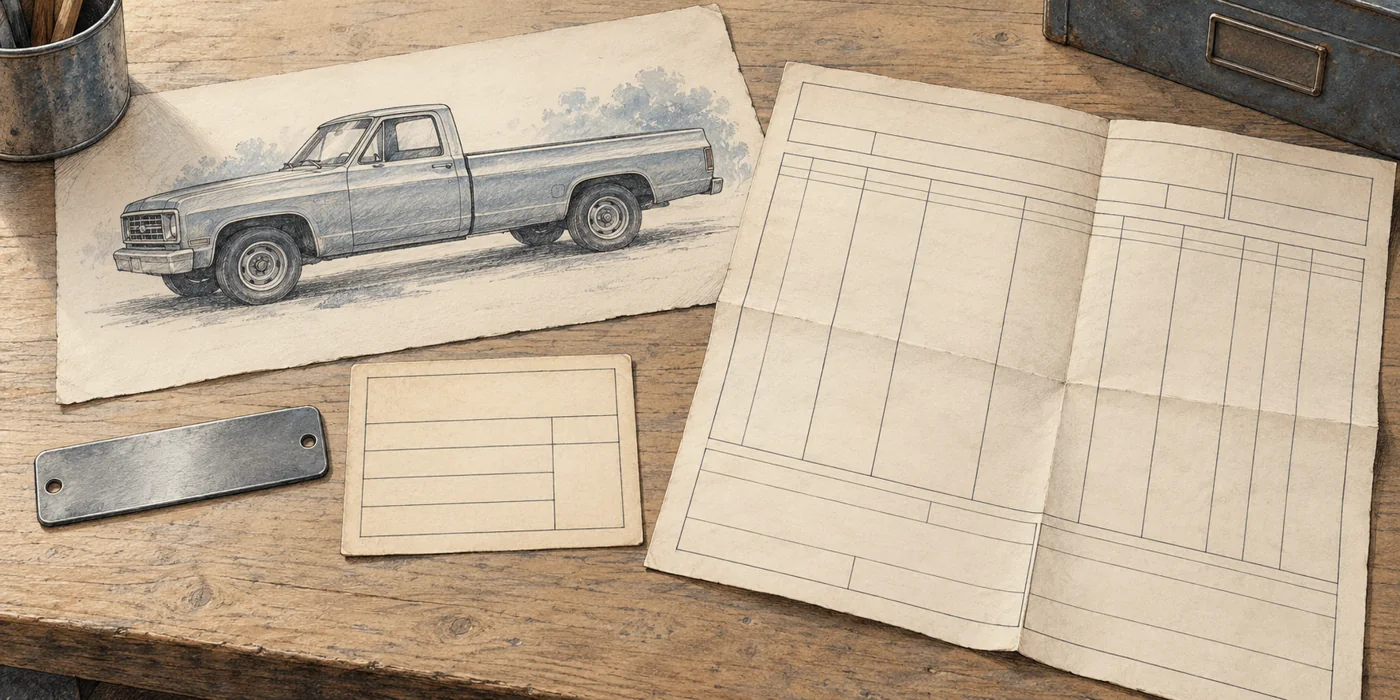
A vehicle identification number (VIN) tells only part of the story. When it is read alongside a Service Parts Identification (SPID) label, build sheet, certification label, invoice, and photographs, a clearer picture of the truck’s original configuration begins to emerge.
What the paperwork tells us
VIN
Division, chassis series, engine identifier, model year, assembly plant, and production sequence—subject to the exact decoding rules for that vehicle.
SPID label
Printed option, paint, and trim codes associated with the vehicle record, often preserved inside the glove box.
Build sheet
Assembly and equipment information that can provide a separate, highly valuable record of the truck’s original configuration.
Also useful: certification labels, invoices, dealer paperwork, warranty records, and detailed photographs.
For Chevrolet pickup combinations documented in the January 1976 Power Teams sheets, and separately sourced engine, transmission and axle identification guidance, see the 1976 Chevrolet Pickup Powertrain Guide. It distinguishes ordering codes from physical component markings and records the limits of each source.
What each record can show
A SPID records equipment at factory shipment. Chevrolet’s 1976 service supplement says this label lists the truck’s serial number, wheelbase, options or special equipment, and paint information. It was also a guide for ordering parts. That explains its purpose. A surviving label still needs to be checked against the truck and other records. It does not prove that every part on the truck today is original.
Source: Chevrolet Motor Division, 1976 Light Truck Service and Overhaul Supplement, ST-330-76, printed 0-3 / PDF 9, Figure 3 and the SPID paragraph. Original page inspected. The final two sentences are research cautions, not an authentication test supplied by GM.
Keep each date with its printed heading. Chevrolet’s 1976 VIN chart calls its year field the model year. A dealer form can record other events. For example, Chevrolet’s inspection form revised in September 1976 has separate date spaces for delivery, service work, and approval. A date in one of those spaces is not automatically the day the truck was built. The form’s revision date belongs to the form, not the vehicle.
Sources: ST-330-76, printed 0-3 / PDF 9, Figure 2; Chevrolet form GSD 99, Rev. 9-76, Passenger Cars and 10–30 Series Trucks—New Vehicle Inspection Procedure. The photographed form comes from a 1977 Corvette discussion. Its printed fields illustrate the distinction; they do not establish the form used for every 1976 truck. No handwritten entries are reproduced here.
Factory charts still need cross-checking. In the retained 1976 Chevrolet service supplement, Figure 2 prints Y beside both V8-350-4 and V8-454-4. GM’s separate truck VIN card, marked 10/75, lists L for the 350 four-barrel and Y for the 454 four-barrel. The duplicated letter in the supplement is a source inconsistency, not evidence that a particular Y-coded truck could have either engine. Keep the cited chart separate from evidence identifying the engine currently installed.
Sources: Chevrolet Motor Division, 1976 10–30 Series Truck Chassis Service and Overhaul Manual Supplement, ST-330-76, service 0-3 / PDF 9, Figure 2; General Motors, 1976 General Motors Truck VIN System, imprint 10/75, PDF 2, light-duty engine-code table.
Finding the assembly plant. Use the assembly-plant box on GM’s 1976 truck VIN card with the vehicle’s complete VIN. The card covers several truck types, so a listed plant is not automatically a pickup factory. For the documented Oshawa and Scarborough distinctions and Canadian examples, continue to the Canadian and Oshawa guide.
An invoice and a warranty folder answer different questions. GM’s archive service describes a factory vehicle invoice as the record GM used to bill the dealer. It includes dealer shipping details, the suggested retail price, and an invoice number. It is a different record from the dealer’s bill to a customer. Chevrolet’s inspection form also directs the dealer to complete owner and dealer information in a separate warranty folder. Read that folder’s own headings and rules before interpreting a delivery or warranty date.
Sources: GM archive service’s invoice description and Chevrolet GSD 99, Rev. 9-76, Delivery Report. The archive description is current service information, not a 1976 dealer instruction. A general 1976 build-sheet date key or warranty-start rule has not been established here.
Do not assume GM can replace a missing 1976 record. The GM Heritage Archive describes its main vehicle-record coverage as starting with 1977. Its service form lists Chevrolet and GMC invoices from 1977 onward, excluding fleet and exported vehicles. Check the stated coverage before ordering. This limit does not mean a 1976 truck never had those papers.
From the research file
The 1976 trim-chart question
GM’s 1973–78 Truck Parts Catalog 51, effective February 1983, records NDW1 in the 1976 trim chart under the red-white-blue color column, numbered 26. The entry is in the Z62 Scottsdale/Sierra Grande knit-vinyl bench-seat row (Code E), within the C-K -03/-63 regular-cab section. The same section identifies YE9 with Silverado/Sierra Classic; it does not place NDW1 in that trim group.
Research status: Verified for the chart’s printed code, color, seat type and model/trim grouping. This is later GM service-parts documentation, not a contemporaneous order form or a particular truck’s build record. It does not by itself prove original installation, a Spirit of ’76 package, production totals or eligibility outside the charted application.
Source: General Motors Corporation, Warehousing and Distribution Division, 1973–78 Truck Parts Catalog, Light Duty Models, Series 10 thru 35, Catalog 51, effective February 1983, “1976 Trim Chart,” printed TP43 / page 43, marked REV. 2-83 (page 47 in the preserved 1,600-page PDF). View the source page. Page image visually checked September 30, 2026.
The trim-chart citation does not establish a meaning for ZV7. Any interpretation of that code, or a claim about its absence from a complete catalog, requires its own cited evidence.
How we check a record
- Capture the complete record, including edges, damage, and surrounding location.
- Transcribe characters exactly and mark anything uncertain.
- Compare codes with factory or authoritative reference material.
- Cross-check one record against the VIN, labels, documents, and vehicle features.
- Record conflicts instead of forcing a conclusion.
See Factory Paperwork Case Studies for examples of matched labels, conflicting documents and incomplete records.
What we preserve
- VIN, model, body configuration, and assembly plant
- Engine, transmission, axle, paint, and trim information
- SPID and build-sheet codes
- Special-edition evidence
- Document and photograph inventory
- Source links, access dates, conflicts, and unresolved questions
Reading historical weight and camper-loading fields
Chevrolet’s August 1975 Camper Loading booklet for 1976 trucks gives these fields distinct meanings:
- GVWR (Gross Vehicle Weight Rating): the manufacturer’s specified loaded weight of the whole vehicle, including the vehicle itself.
- GAWR (Gross Axle Weight Rating): the manufacturer’s load-carrying rating for one axle system, measured where its tires contact the ground. Front and rear ratings are separate.
- CWR (Cargo Weight Rating): the manufacturer’s cargo-carrying figure, excluding an occupant allowance calculated at 150 lb per designated seating position. For a slide-in camper, the booklet’s cargo accounting includes the camper, additional camper equipment, camper cargo and passengers in the camper.
GVWR and GAWR are not available payload figures. Adding the two axle ratings does not establish GVWR or CWR: the booklet treats whole-vehicle weight, individual axle loads and cargo weight separately.
A GVWR or axle rating can appear beside a slide-in-camper warning. Chevrolet’s August 1975 booklet for 1976 trucks says pickup models with CWR below 500 lb were not recommended for slide-in campers and received a warning on the VIN plate. This is one documented pickup rule, not a way to infer a missing CWR or explain every warning on a Blazer or GMC. It does not establish a surviving truck’s present capacity.
The A and B fields describe position: A is the forward boundary and B the rearward boundary of the recommended cargo center-of-gravity zone, both measured in inches from the rear of the truck bed. The booklet associates this zone with the full CWR. These numbers are not weight ratings or wheelbase dimensions.
The booklet describes the plate’s CWR as an as-manufactured figure and separately accounts for equipment added after manufacture. A surviving inscription records that historical specification; it does not establish a restored or modified truck’s present capacity or condition.
Source: Chevrolet Motor Division, 1976 Chevrolet Truck Camper Loading—Consumer Information, August 1975, printed/PDF pages 3–4 and 6; title and scope on pages 1–2. Preserved 62-page original scan. These definitions and limitations come from that dated Chevrolet publication, not a complete GMC or Canadian application table. See the RPO and Option Guide’s S5 entry for the preserved-source bibliography.
GCW in a trailering chart means gross combination weight. GMC’s Recreation Vehicles brochure, marked ADV.76-2 (8-75), defines it as the combined weight of the loaded truck and trailer. Its pickup chart lists model, engine, transmission and axle ratio, with a separate row for the GCW shown on a Trailering Special nameplate. That nameplate figure is not the trailer’s weight alone. The chart’s equipment requirements and California exclusions must stay with the applicable entries. A surviving nameplate alone does not establish original equipment or present towing capacity.
Source: GMC Truck & Coach Division, Recreation Vehicles, ADV.76-2 (8-75), back cover / PDF5, “Pickup Trailer Towing Equipment Selector Guide.” Model/equipment rows and California footnotes remain part of the dated source.
Frame service numbers and vehicle identity
GM’s February 1983 Catalog 51 lists frame assembly 14016408 for both 1973–75 and 1976–77 K1 trucks with a 117.5-inch wheelbase, subject to the catalog’s service conditions. That service-part number alone cannot uniquely establish a truck or its model year. The entries do not establish that the number was stamped on every original frame, decode a partial VIN or assembly date, or prove original installation. Original 1976 C/K factory instructions for frame-stamp locations and formats remain needed.
Source: GM Light Truck Parts Catalog 51, group 7.003, printed 7-1 / PDF 973, REV. 2-83. Independent GMPartsWiki scan.
Have paperwork for a 1976 truck?
For your own records, keep one full view of the label or document plus close-ups. The submission page currently requests text research details or public source links; file uploads are temporarily paused. Please do not link to private documents. You may cover personal details and VIN characters you prefer not to share. Add the truck’s year, make, model, and history if you know them. Faded, torn, or incomplete records may still help. Unreadable details can stay unknown.
Privacy: Personal information is not published without permission. VINs and documents may be partially concealed when appropriate.