RareTruckInfo investigates the stories behind special and unusual Chevrolet and GMC trucks: commemorative editions, appearance packages, regional promotions, dealer-created trucks and unusual factory combinations. The 1976 pilot remains the foundation, with separately scoped 1985 and 1986 promotional-offer notes below.
FLAGSHIP RESEARCH FILE
Spirit of ’76 Survivor Registry
The registry brings together surviving trucks, VINs, photographs, documents, sale history, and owner-supplied evidence. Inclusion records a research lead; it does not automatically authenticate a truck or package claim.
Related-year promotional offers
1985 Chevrolet Outdoorsman promotional offer — what the sales material supports, with production and installation questions kept separate. This related-year article does not expand the 1976 registry or establish a factory RPO.
1986 GMC Gold Medal program: the February revision. A February 1986 dealer letter records a Work-Ready V8 addition, while package contents and individual-truck originality remain separate questions.
Open Questions
Chevrolet
- Spirit of ’76
- Bonanza
- Promotional, regional, dealer, and other reported packages
Research distinguishes factory documentation from dealer installation, later reproduction, and owner-added appearance items.
GMC
- Olympic Edition
- Royal Sierra
- Promotional, regional, dealer, and other reported packages
A repeated name, badge, stripe, or color combination is treated as a lead until stronger evidence supports the exact claim.
Explore published examples: Chevrolet Bonanza · CCL146S183728, GMC Olympic Edition · TCL1461519708, and GMC Royal Sierra presentation · TCL146S511045. Each record distinguishes photographed or documentary evidence from claims that remain unresolved.
Documented package findings
Chevrolet Big-10: C10/F44
Chevrolet’s 1976 factory specifications explicitly identify Big-10 as C10/F44 in the conventional-drive regular-cab table dated August 29, 1975. The January 16, 1976 model selector lists both the 6½-foot CC10703 and 8-foot CC10903 with Fleetside E63/F44 or Stepside E62/F44 choices. This establishes a named Chevrolet configuration with both box styles and lengths. The dated C10 ordering sheets supply the separate engine, rating and equipment conditions. The same factory heading does not establish GMC Heavy Half naming, universal decals or any individual truck’s authenticity.
Sources: Chevrolet standard specifications, printed 17 / PDF 20, August 29, 1975; Pickup Model Selector, printed 1 / PDF 4, January 16, 1976.
GMC F44 and the Heavy Half name
F44 appears on the photographed GMC SPID for TCL146S517267 beside the words “HEAVY DUTY CHASSIS.” The label separately identifies model TC10903. A metal plate bearing the same VIN records 6,050-lb GVWR. These are observations from this truck’s documents, not a definition of the equipment or rating supplied with every GMC F44 configuration.
A contemporary dealer offer supplies another use of the code. Boston, New York’s April 7, 1976 town-board minutes record Bruno GMC Truck Sales Corporation’s bid for a 1976 half-ton pickup, model C1500/F44. The town awarded the contract to a Chevrolet dealer, so this record does not establish delivery of a GMC.
GMC’s January 30, 1976 data book, Pickup p. 20, lists C1500/F44 under Fender-Side Pickup (E62): TC10703 with a 117.5-inch wheelbase and TC10903 with a 131.5-inch wheelbase. Ordinary C1500 repeats those model numbers, so they alone do not identify F44. Heavy Half naming and complete F44 specifications remain unresolved. The Canadian K-series GVW tables do not replace this truck’s rating plate or define F44. Historical ratings also do not establish present safe loading capacity.
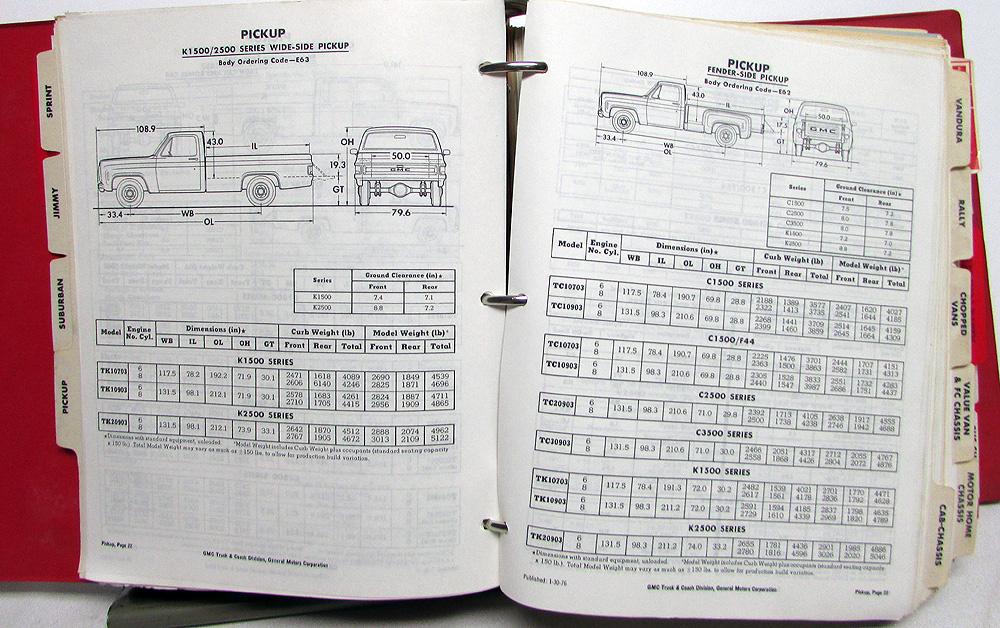
Sources: VIN-matched SPID and rating-plate photographs on the Texas Trucks and Classics dealer page, also syndicated by ClassicCars; one photographic source chain. Town of Boston minutes, April 7, 1976, printed p. 30 / PDF 103. General Motors of Canada, pickup brochure GM-4703, printed pp. 8–9 / PDF 5; no printed issue date established.
Chevrolet Inflation Fighter
A Chevrolet Motor Division pickup mailer explicitly headed for 1976 advertises the Inflation Fighter as a special Custom Deluxe configuration. Its listed equipment includes a full-foam seat, painted rear step bumper and a special heavy-duty three-speed manual transmission with larger gear diameters. The panel names Big-10 half-ton and ¾-ton pickups and restricts the offering to two-wheel-drive models.
This establishes Chevrolet’s use of the name and those advertised features. The panel discusses the fuel compatibility of six-cylinder engines but does not give a complete engine/transmission ordering table or explicitly prohibit V8s. It prints no unique Inflation Fighter option code, transmission manufacturer or production total, so those details remain unresolved. The name alone does not authenticate a surviving truck.
Source: Chevrolet Motor Division, 1976 pickup dealer mailer, Inflation Fighter panel and issuer block, carrying the literal imprint “975”; Gerken Chevrolet dealer-imprinted copy, preserved listing photographs from eBay item 365625098657, reviewed September 21 and October 3, 2026. The cover explicitly identifies 1976; the imprint is not treated here as a unique publication number or a vehicle-production date.
GMC’s 1976 Indianapolis 500 limited edition
GMC’s 1976 Indianapolis 500 dealer folder states that 500 limited-edition pickups had been made and shipped to participating GMC dealers. It identifies the race as May 30, 1976; the folder carries form number TSP-76-16-4-76. This is GMC’s advertised dealer-distribution quantity, not an independently audited production total or a count of trucks used at the race. It does not establish any individual truck’s authenticity.
Sources: GMC dealer folder, front; GMC dealer folder, back and form number; archive context.


Chevrolet Sport Truck: 9G4 and 9G5
A Chevrolet Sport Program sheet dated September 1975 documents a specific Stepside offering with COPO (Central Office Production Order) 9G4 white striping and stated equipment/GVW restrictions. It does not define every later Sport configuration.
Source: Chevrolet Motor Division, General Motors Corporation, Chevy Sport Program, September 1975.
GM’s February 1983 light-truck parts catalog identifies 1976 Chevrolet Sport Truck striping for both Stepside and Fleetside pickups. Printed page 16-22 links COPO 9G4 to the CK1 Stepside application and COPO 9G5 to the CK1/2 Fleetside application. This later factory parts reference documents the names, codes and listed body applications. It does not supply a complete 1976 ordering matrix or establish that every package shared the same equipment.
Source: General Motors, Light Truck Parts Catalog 51, revision 2-83, printed page 16-22, group 16.166. Supporting hood-stripe rows: printed page 8-1, group 8.055. Scans hosted by the independent GMPartsWiki archive. Additional appliqué listings: group 17.507, printed 17-22 and printed 17-23, each marked REV. 2-83.
For a separate model-year example, read 1980 Chevy Sport: One Name, Two Pickup Bodies. Its dated Z77 descriptions compare Fleetside and Stepside detailing; they do not establish continuity with the 1976 codes above.
GMC COPO 9G6 in service-parts literature
Catalog 51’s group 17.507 lists 1976 GMC CK1/2 two-door Wideside appliqués under COPO 9G6. These are service-parts applications. The pages do not name Impact ’76 or establish that COPO 9G6 identifies that program, and they do not establish complete ordering eligibility.
Source: General Motors, Light Truck Parts Catalog 51, group 17.507, printed 17-23, REV. 2-83. Scan hosted by the independent GMPartsWiki archive.
Royal Sierra and Spirit of ’76 wheel-cover applications
GM’s February 1983 Light Truck Parts Catalog 51 records a specific Royal Sierra wheel-cover application. In group 5.858, GMC cover 355822 is listed with RPO PA-1 and a reference to note 11, which adds C-15 models with Royal Sierra packages A, B and C. This is a later service-parts application; the footnote does not give a separate Royal Sierra year range or define the complete contents of a 1976 package.
The same leaf separately lists cover 369080 under the Spirit of ’76 heading and RPO PA-3, with an application expressly limited to 1976 C-1 two-door cab models, Chevrolet only. That Chevrolet application should not be transferred to GMC. Neither wheel-cover code by itself authenticates a special-edition truck, and the catalog does not establish what remains original on an individual survivor.
Source: General Motors, 1973–78 Light Truck Parts Catalog 51, printed 5-83, group 5.858, REV. 2-83 (retained original PDF page 907). The scan also repeats this leaf at PDF page 1307; the repetition is not independent evidence.
GMC Impact ’76 and Motortown
The GMC Impact ’76 pickup folder, marked “Revised 3-76,” describes selecting the GMC truck and then adding Motortown’s Basic Appearance Package. Its listed pickup choices include Wide-Side bodies, 117.5- or 131.5-inch wheelbases, and C/K 1500 or 2500 series; these are not a complete combination-by-combination ordering table. The basic package lists a front air dam, front and rear flares, custom outside mirrors, and body/hood striping. Other pictured accessories were optional.
Sources: Impact ’76 pickup application and equipment; basic/optional distinction and March 1976 revision; archive context.


The separate GMC Suburban Impact ’76 folder calls Suburban the program’s third vehicle, following Pickup and Jimmy. It directs the buyer to choose the Suburban’s available equipment and then order Motortown’s Basic Appearance Package: multicolor appliques, front and rear wheel flares, a front air dam, and custom outside mirrors painted to match the primary body color. Driving lights and audio equipment are additional Motortown options; the folder separately says rally wheels and tires may be ordered from GMC. This documents an advertised GMC/Motortown offering, without identifying the installation location, a complete model-eligibility table, or a production total. The folder’s exact publication date remains unresolved.
Source: GMC/Motortown, Suburban Impact ’76 folder, PDF pages 2 and 4.
Canadian GMC Olympic package details
The Canadian Olympic Edition pickup sheet lists ZE2 for C and K pickups, all series, with Wide-Side bodies only, and requires E63 and white exterior paint. Listed equipment includes DG4 chrome mirrors, V22 chrome grille, V46 chrome front bumper, B96 wheel-opening moldings, Olympic paint, hood ornament and decals. N67 Rally wheels are listed with an exception for 2500 and 3500 series. This is Canadian package guidance; it does not establish U.S. availability or authenticate a particular truck.
Sources: Canadian Olympic Edition pickup package sheet; archive context.

Official-use fleet and retail Olympic Editions
GM of Canada’s 1975 annual report distinguishes its planned supply of 1,500 official Olympic-use vehicles from a limited retail series produced and sold in Canada. It expressly includes Chevrolet and GMC pickups and vans in that retail program. It does not provide their production totals or division-specific option codes; the dated GMC ZE2 dealer sheet remains separate evidence for that package.
Source: General Motors of Canada Limited, Annual Report 1975, “1976 Olympic Games,” unnumbered inside-front page / PDF p. 2. University of Alberta Library scan. The page includes officer changes effective May 1, 1976; the report’s cover year is not the program’s production date. View the original report.
1976 Chevrolet Bonanza
Period advertising presents Bonanza as a Chevrolet equipment-value program. A Welch Chevrolet advertisement in the San Benito News on February 18, 1976, page 6, offered Bonanza Fleetside pickups with three option packages priced below the same options purchased separately. The advertisement supports the program’s contemporary name and three-package sales structure, but does not identify the contents or RPO code of each package. A Don Crow Chevy Trucks advertisement in The Roundup, September 3, 1976, p. 12, offered a new 1976 half-ton Bonanza with a 454 V8. This documents one dealer offer, without establishing factory installation or package contents.
Surviving vehicle documents supply a more specific code connection. The photographed Service Parts Identification label for CCL146A121093 lists YG8 Bonanza Package C and Z62 Scottsdale Equipment as separate entries, together with 73E red knit vinyl trim. Chevrolet’s 1976 Dealer Order Guide independently lists Z62 Scottsdale under Decor on C10 Pickup page 3, revised February 18, 1976. Bonanza package identification and Scottsdale trim should therefore be recorded separately.
Compare the published record for CCL146A121093 with CCL146S183728, whose photographed label records YG8, Z62 and 26E Blue/White knit trim. The red-trim example is important evidence that YG8 cannot identify a Spirit of ’76 truck by itself. A 26E or NDW1 trim entry also requires its own context; see the Spirit of ’76 Registry for the factory trim and service-parts evidence and its limits.
A truck’s SPID lists that vehicle’s equipment. It does not, by itself, distinguish the items included in a Bonanza package from separately ordered options. A complete 1976 package-contents and eligibility table, including applicable revisions and prices, remains to be verified from legible period ordering material. These documented examples do not establish a production total.
Sources: Welch Chevrolet advertisement, San Benito News, February 18, 1976, p. 6, preserved page-view image; Chevrolet 1976 Dealer Order Guide, C10 Pickup p. 3, revised 2-18-76; photographed GM Service Parts Identification label for CCL146A121093, SMClassicCars gallery image 3; published VIN-specific record for CCL146S183728.
Related car-based models: 1976 GMC Sprint Sierra Madre del Sur
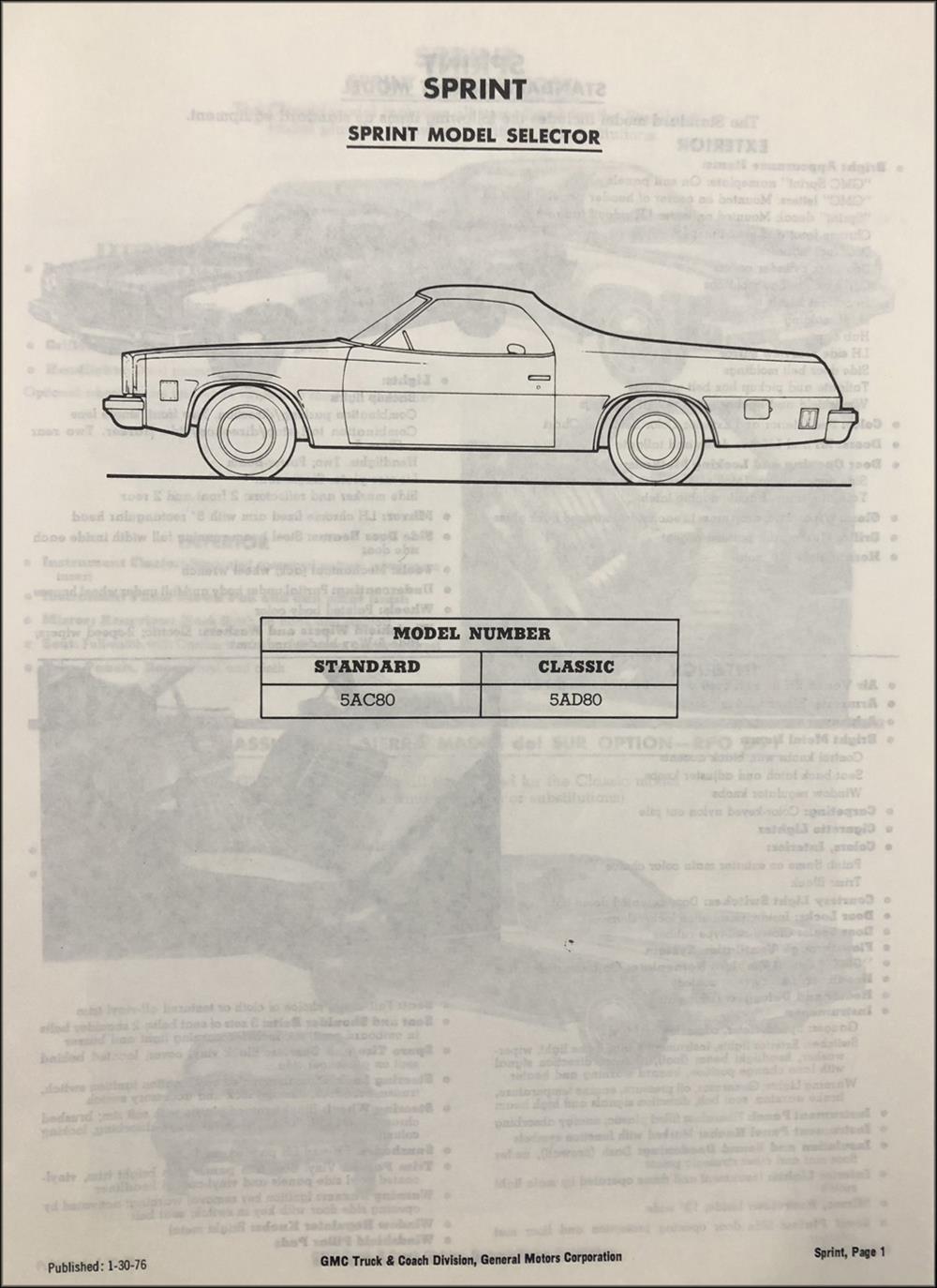
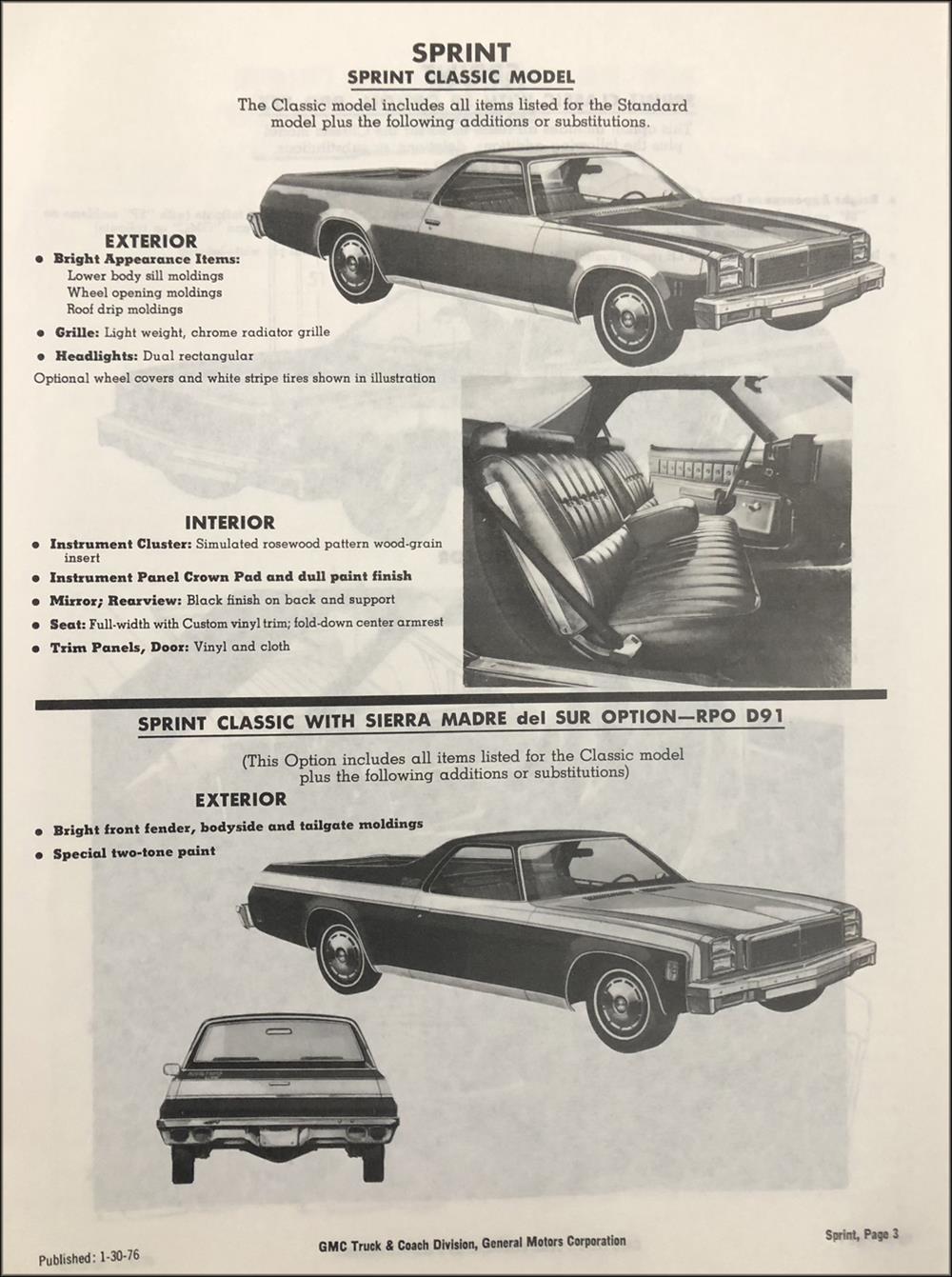
Sierra Madre del Sur is documented as RPO D91 on the 1976 GMC Sprint Classic. Sprint belongs to the separate car-based model line described in our project scope guide; its model numbers and option evidence should be kept separate from C/K pickups and Canadian-market ordering material.
The GMC Light Duty Data Book’s Sprint Model Selector, published January 30, 1976, identifies these two models. These are model numbers, not individual vehicle VINs.
| Sprint model | Model number |
|---|---|
| Standard | 5AC80 |
| Classic | 5AD80 |
The same publication’s Sprint page 3 describes Classic as retaining Standard equipment with listed additions or substitutions. Its D91 section then retains the Classic equipment and adds bright trim along the front fenders, body sides and tailgate, plus special two-tone paint. This establishes a cumulative equipment description. It does not make D91 a package for every GMC pickup.
The August 1975 Sprint brochure illustrates Sierra Madre del Sur and describes the same paint-and-molding treatment. Other pictured items have their own qualifications: swivel bucket seats are available with Sprint Classic or SP, and the illustrated cargo cover is supplied by other manufacturers. The brochure describes Sprint SP separately; its equipment list does not establish D91 content or whether the two options could be combined.
The missing paint source is specific. A retailer-hosted reproduction of GMC’s 1976 color-album index assigns Sprint paint, vinyl-roof and interior compatibility charts to pages 15–16, but those leaves have not been recovered in the reviewed material. Exact D91 color pairs, paint codes, ordering price and complete powertrain or option-combination restrictions remain unverified. These sources also supply no production total or Canadian ordering conclusion. A surviving Sprint needs its own VIN-linked option evidence before it can be identified as D91.
Sources: GMC Truck & Coach Division, 1976 Light Duty Data Book, release 76B-2 Part 1, Sprint page 1, Model Selector and Sprint page 3, Classic and Sierra Madre del Sur, both published January 30, 1976; retailer-hosted photographs of original pages. GMC, Sprint, ADV.76-5 (8-75), printed pages 2–3 / PDF 2, with form/date and U.S. imprint on back cover / PDF 3. GMC, 1976 Truck Exterior Colors and Interior Trims, retailer-hosted color-album index reproduction; the index locates the missing leaves but does not supply their contents. These publication dates do not establish a package’s introduction date.

1975 GMC: Gentleman Jim and Beau James
Gentleman Jim reaches dealers
Photo gallery: See Truck Rodeo’s Gentleman Jim exterior and interior photographs, including black-and-gold bodywork, bedside lettering, bucket seats and console. The publisher associates the featured truck with VIN TCY145S503130 in its caption; the reviewed photographs do not show a readable VIN plate. Period promotional images in the carousel are historical context, not photographs of that individual truck. Instagram may require sign-in.
A GMC Truck & Coach press release dated February 1975 introduced Gentleman Jim as a limited-edition half-ton pickup and the first in a planned series of specially styled pickups for the 1975 model year. Cagle’s GMC in Muskogee, Oklahoma, advertised its arrival on February 14. These sources establish factory publicity and a local dealer appearance, rather than an exact national launch day.
The release describes black-and-gold styling, a 350 V8 and automatic transmission, saddle bucket seats with a console, and air conditioning. It separately lists dealer-installed accessories: floor mats, bed tie-down rods, splash shields, quartz-halogen passing beams, a tonneau cover and locking lug nuts. That distinction matters when examining a surviving truck.
Sources: photographed two-page GMC press release, February 1975; Cagle’s advertisement, Muskogee Daily Phoenix and Times-Democrat, February 14, 1975, p. 15.
Beau James in print—and on a build sheet
Photo gallery: View the Beau James exterior, interior and detail photographs at Bring a Trailer (lot 202134, VIN TCZ145S510807). The gallery shows the blue-and-silver bodywork, bedside lettering, hood ornament and blue interior. The seller reports a later-style replacement hood, so the truck’s present appearance should not be treated as a complete guide to factory-original details.
Cagle’s advertised Beau James on May 15, 1975, saying it had only two of this model and listing factory air conditioning, power brakes and power steering. Jackie Cooper’s Cooperville in Yukon advertised it 36 days later, on June 20, calling it a limited edition. These are dated local offers, not production totals or universal equipment specifications; neither advertisement prints a model year.
One documented 1975 example, VIN TCZ145S510807, offers a closer look. Its photographed build sheet includes the literal entries “9G2 BEAU JAMES DC,” “9A6 PROMO PKG #2” and “4001ZF SPEC PAINT,” and names Cape GMC-Pontiac in Cape Girardeau, Missouri. The VIN appears on its options label, warranty folder, title and registration paperwork. The registration receipt records a May 30, 1975 purchase and a $5,600 price; the title was issued June 20. These readings document this truck and do not establish a code rule for every Beau James.
Sources: Muskogee Daily Phoenix and Times-Democrat, May 15, 1975, p. 43; Oklahoma City Times, June 20, 1975, p. 44; Bring a Trailer lot 202134 and its vehicle-document photographs, supplied copies visually reviewed October 16, 2026. Seller statements about ownership, mileage and originality remain separate from the document readings.
Gentleman Jim and Beau James: comparing the paperwork
The photographed build sheet for Gentleman Jim-listed VIN TCY145S503871 prints “9A5 PROMO PKG” and “9G1 DECALCOMANIA,” together with black/gold paint-placement instructions, dark-saddle trim and a bucket-seat entry. The paint instructions are printed/typewritten. “Gentleman Jim” is a handwritten annotation of unknown date and authorship.
A separate truck, VIN TCY145S503937, has a Service Parts Identification (SPID) label reading “Z45 GMC PROMOTIONAL PACK” and “001 SPECIAL PAINT”; it does not print the Gentleman Jim name. These are different VINs and document types, so the records cannot establish that 9A5 and Z45 are equivalent.
For Beau James VIN TCZ145S510807, the build sheet prints “9G2 BEAU JAMES DC,” “9A6 PROMO PKG #2” and “4001ZF SPEC PAINT,” with blue/silver paint instructions. Its matching SPID also lists 9A6. These are vehicle-specific document readings; they do not establish a universal Gentleman Jim–Z45 relationship, complete package specifications, production totals or the physical documents’ authenticity.
Sources: AutoHunter lot 22680489, photographed build sheet for TCY145S503871; privately held SPID photograph for TCY145S503937; Bring a Trailer lot 202134, Beau James document photographs, supplied copies. Relevant photographs visually reviewed October 17, 2026.
Still unresolved: production totals, complete ordering rules and a documented Gentleman Jim–Z45 connection. The sources above also do not establish that Beau James was the second model in GMC’s planned series.
Midnight Special remembered by a GMC dealer
Gerson M. Goldberg recalled a Midnight Special promotion organized by the Connecticut and Western Massachusetts GMC Dealer Advertising Association. He remembered black, long-wheelbase C1500 Wideside pickups with six-cylinder engines and three-speed transmissions. Participating dealers installed the Midnight Special decals, and the association advertised the trucks together.
Goldberg qualified his memory and did not establish an exact model year. His account is useful dealer-history testimony, but it does not establish a factory option code, total production or a surviving truck’s identity. He also said he did not know whether Street Coupe was organized the same way.
Source: Gerson M. Goldberg, “Special Edition GMCs,” GMC Times, printed p. 7; preserved one-page extract, PDF p. 1, visually reviewed October 28, 2026. The held filename attributes the extract to June 2013, but the supplied page does not show an issue date.
How an Edition Is Documented
Each claim is evaluated separately using factory literature, period advertising, VINs, SPID labels, build sheets, invoices, certification labels, physical markings, dated photographs, and documented survivor patterns. The conclusion receives one of six statuses: Verified, Probable, Unverified, Incorrect, Superseded, or Not Assessable.
Badges, decals, or a familiar color combination are not enough by themselves to establish that a truck was built as a special edition. Read the complete RareTruckInfo research standard for the evidence hierarchy and correction policy.
Read Folklore & Claims for the histories behind reported truck editions, or browse the Reference Library for factory manuals and identification guides.
Have a special-edition truck or document?
Share text research details, corrections, or public source links. File uploads are temporarily paused; please do not link to private documents. Submitted material is reviewed privately.