Factory codes are useful only when the source, model, and model year agree.
This guide identifies selected Regular Production Option codes documented in Chevrolet’s 1976 light-truck literature. It is a reference for reading factory paperwork, not a universal decoder and not a substitute for a truck’s own documentation.
On this page: Option codes · G80 restrictions · Camper packages · Unresolved codes · Sources
Primary documents: Chevrolet Motor Division, 1976 Chevrolet Truck vehicle information kit, including individually dated Pickup sheets; and Chevrolet’s 1976 Suburban price-and-option list, “Options and Accessories When Installed by Chevrolet,” printed pp. 15–22, published January 16, 1976; its prices apply to vehicles manufactured on or after December 23, 1975. Suburban-specific inclusions and exclusions below come from that list. Codes and package contents can vary by series and body style; this page does not assign Chevrolet meanings to GMC codes.
What an RPO code can—and cannot—prove
A factory option list shows how Chevrolet used a code for the models and equipment it covers. It does not show that a particular truck had that option. To show that it did, you usually need a genuine record that matches the truck’s VIN: a SPID label, build sheet, dealer invoice, warranty record or similar factory record.
Surviving paperwork must also be read in context. A replacement glovebox door, copied label, later repaint, or swapped component can create an apparent match that is not original to the vehicle.
Keep SPID wording and trim interpretation separate
These four GMC research records show why an option code, its printed description and a seller’s trim name should be recorded separately:
- TCS346B521620: the VIN-matched SPID reads YE9 SILVERADO EQUIPMENT.
- TCL146A505787: the VIN-matched SPID reads Z84 CHEYENNE EQUIPMENT.
- TKL146Z514127: an associated SPID reads YE9 SILVERADO EQUIPMENT. Its VIN ending is obscured; the separate metal plate provides the complete VIN.
- TCS166F508066: the VIN-matched SPID instead prints 1YE9 SIERRA CLASSIC EQUIP. The leading 1 is retained without assigning it a meaning.
Chevrolet’s 1976 service supplement separates option numbers from descriptions, relates SPIDs to factory-shipped equipment and identifies T as GMC. GMC’s pickup data book, pp. 4–5 (right leaf published January 30, 1976), describes YE9 Sierra Classic as additions or substitutions to High Sierra equipment for Regular Cab, and to Sierra Grande equipment for Crew Cab/Bonus Cab. Catalog 51’s 1976 Trim Chart, revised February 1983, pairs Cheyenne/High Sierra with Z84 and Silverado/Sierra Classic with YE9 in the applicable C/K trim rows. That later reference supplies code-and-name context; it does not explain the choice of wording on a particular 1976 label.

The comparison establishes differences among these photographed labels. It does not establish the cause, a universal naming rule, or a misbuilt or counterfeit truck. The unresolved question is how the descriptions on these SPIDs were selected; no plant- or form-specific printing instruction has been recovered in this review. Artifact authenticity and present equipment remain separate questions.
Factory references: Chevrolet ST-330-76, printed 0-3 / PDF 9, Figures 2–3 and SPID explanation; General Motors, Light Truck Parts Catalog 51, REV. 2-83, TP43 / printed 43 / PDF 47. The linked vehicle records retain each photograph’s source and identity limits.
Paint names can vary by source
The GMC color-album index and these three label photographs use different names beside matching paint numbers:
| Paint number | GMC index name | Selected SPID wording |
|---|---|---|
| 25 | Dark Bright Blue (M) | CATALINA BLUE on TCL146A505787 |
| 81 | Dark Gold (M) | MOSS GOLD on the partly VIN-readable label associated with TKL146Z514127 |
| 60 | Neutral | SANTA FE TAN on TCS166F508066 |
This compares names only. The complete label entries, clipped endings and identity limits remain in the linked records. Matching numbers do not establish a paint formula, identical paint products or a truck’s original finish.
Source: GMC Truck & Coach Division, 1976 GMC Truck Exterior Colors and Interior Trims, retailer-hosted Color Paint Samples index reproduction, rows 25, 81 and 60; (M) is the index’s metallic notation. No general issue date is visible on this leaf; its dated availability footnotes are not its publication date. The linked records retain the label sources.

Read the code in its printed field
Read a printed entry with its column heading and document instructions. Chevrolet’s C10 pickup order sheet revised March 26, 1976 requires separate front, rear and spare tire selections. In its G78-15/B row, XGS is in the front column, YGS in the rear column and ZGS in the spare column. The section’s index separately labels option numbers and tire codes, and expressly says it is not for ordering purposes. These field roles do not turn the tire selections into a named equipment package.
Source: Chevrolet Motor Division, 1976 Dealer Order Guide, Pickup printed/PDF 1 and C10 Pickup printed/PDF 5, both revised March 26, 1976. Selected preserved originals inspected; no verified public scan URL is available. The entries describe the cited C10 table, not a universal tire-code or SPID-prefix rule.
Keep tire size, construction and load range separate. The same March 26, 1976 C10 sheet lists L78-15/B, L78-15/C and radial white-stripe LR78-15/C separately. Chevrolet’s 1976 service supplement, printed 10-3, pairs load ranges B/C/D/E with the former 4/6/8/10-ply ratings under ‘Replaces Ply Rating.’ Those are rating equivalents, not a count of the plies in an individual tire. This explains period notation, not modern tire suitability or capacity.
GMC provides a useful comparison in its 1976 color album. The color-paint index places White 12 and Light Blue 20 under an RPO heading; its instructions identify the entries as solid-paint RPO numbers and give model applicability separately. Thus a rule that every RPO must have one fixed three-character form would misread this GMC source. This does not transfer GMC paint numbers or ordering rules to Chevrolet.
Source: GMC Truck & Coach Division, 1976 GMC Truck Exterior Colors and Interior Trims, Color Paint Samples index, RPO/model/page columns and instructions. This is a retailer-hosted index reproduction from the known album; no general issue date is visible on this leaf. Its dated color-availability footnotes are not the album’s publication date.
Keep later service definitions dated. GM’s February 1983 Catalog 51 describes the SPID’s SE # as a four-digit reference used for parts inquiries. It separately explains the option number/description area, interior-trim and paint references, and COPO (Central Office Production Order) entries in the option area. These are distinct fields in that service reference. They do not establish a universal 1976 code grammar, make NDW1 an equipment-package RPO, or equate an SE reference with a GMC SEO code. SEO is retained as printed in the source; its expansion and 1976 ordering rules remain unresolved.
Source: General Motors, 1973–78 Light Truck Parts Catalog 51, printed TP5 / page 5, preserved PDF 9, REV. 2-83. The selected original was inspected; no verified public page link is available. The VIN/SPID reference separately documents NDW1’s trim-chart context.
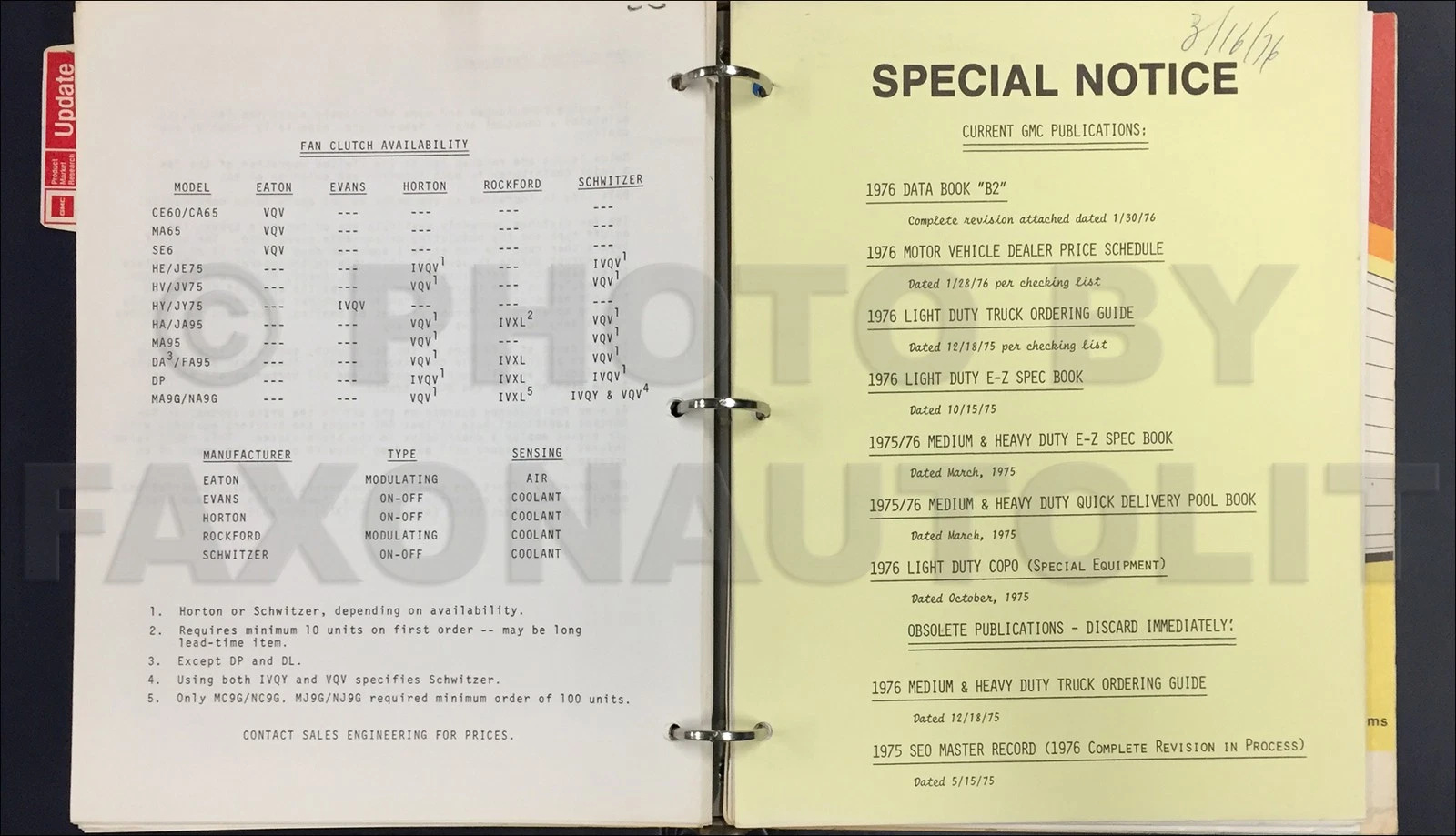
For the unresolved GMC ordering terminology, a period publications notice identifies a 1976 light-duty COPO special-equipment reference dated October 1975. It lists the light-duty ordering guide dated December 18, 1975 separately. The same notice marks the 1975 SEO master record, dated May 15, 1975, obsolete and says a complete 1976 revision was in progress. These are precise document leads; the notice does not provide their code definitions, dealer/zone order-number rules or package contents. Its handwritten March 16, 1976 notation is not a printed issue date.
Source: GMC, Special Notice: Current GMC Publications, right-hand unnumbered leaf photographed in a dealer bulletin album. This previously reviewed source is used as a publication locator only.
For vehicle records, preserve the complete printed entry before interpreting it. A leading character in a SPID entry such as 1A01 should remain in the transcription until an applicable field key establishes its role; any normalized lookup belongs separately. Keep dealer invoice wording literal too. A plain-language equipment line does not itself establish an RPO, SEO, installation stage or named factory package.
Series, body, and trim identifiers
- E62 — Stepside pickup body.
- E63 — Fleetside pickup body.
- Z62 — Scottsdale equipment. The published package included appearance and interior upgrades; its exact content depended on the covered body style.
- Z84 — Cheyenne equipment. Documented in the Chevrolet truck data book.
- YE9 — Silverado equipment. A package code, not merely a fender nameplate. The Suburban list ties it to trim, instruments, carpeting, moldings, insulation, and other equipment.
Suburban package source: the Z62 Scottsdale and YE9 Silverado descriptions appear on printed/PDF page 16. They describe Suburban equipment; pickup body and trim entries require the separately cited pickup literature. Pickup body-ordering codes E62 (Stepside) and E63 (Fleetside) appear on Pickup Page 1 (PDF 4), dated January 16, 1976. The regular-cab trim chart on Pickup Page 12 (PDF 15), dated August 29, 1975, pairs Z62 with Scottsdale, Z84 with Cheyenne, and YE9 with Silverado; that chart’s regular-cab scope should be retained.
Paint, moldings, and exterior trim
- ZY1 — Solid exterior paint.
- ZY3 — Special two-tone paint. On the Suburban, the secondary color occupied the area between the upper and lower side moldings and included YG1.
- B84 — Bright body-side spear molding.
- B85 — Bright upper body-side moldings.
- YG1 — Upper and lower body-side moldings.
- YG2 — Wood-grained exterior trim.
- V22 — Chromed grille.
- V37 — Chrome front and rear bumpers.
- VE5 — Deluxe bumpers.
- V31 — Front bumper guards.
The molding codes were not freely interchangeable. The Suburban list records exclusions among B84, B85, YG1, YG2, and ZY3. That matters when evaluating a claimed factory paint-and-trim combination.
Suburban source pages: page 19 for paint and molding relationships; page 22 for YG2; page 17 for bumper options; page 18 for V22.
Roof marker lamps are not a stand-alone tonnage identifier. Chevrolet’s March 26, 1976 C10 and K10 pickup option sheets list U01 roof marker lamps, excluding YF5 California-emission applications. This establishes a listed half-ton application; it does not show that lamps now fitted to a survivor are original.
Source: Chevrolet Motor Division, 1976 Dealer Order Guide, Pickup section, C10 printed/PDF page 6 and K10 printed/PDF page 34, both revised March 26, 1976. The preserved source leaves were visually checked; no public scan link has been verified.
Interior, instruments, and convenience equipment
- Z52 — Full-depth foam front seat.
- Z53 — Voltmeter, temperature gauge, and oil-pressure gauge.
- BC2 — Wood-grained instrument panel. The Suburban list required Z53 and excluded YE9.
- U35 — Electric clock. Not available with U16; without YE9, the published Suburban application included Z53.
- U16 — Tachometer. V8 only in the published Suburban application; not available with U35.
- U37 — Cigarette lighter.
- C91 — Dome lamps.
- A01 — Soft-Ray tinted glass, all windows.
- A33 — Electric tailgate window.
- C60 — Front air conditioning.
- C69 — Front and rear roof air conditioning.
Suburban source pages: page 18 for instruments, clock, glass, lamps and instrument-panel restrictions; page 19 for U37 and Z52; page 17 for air conditioning; page 22 for A33.
A separate-option exclusion does not necessarily mean that a trim package lacked the feature. The Suburban list excludes BC2 with YE9, while its YE9 description includes a wood-grained instrument cluster and Z53 gauges. The source uses different panel and cluster descriptions; these entries do not establish identical part numbers or original equipment on a surviving truck.
Source: Chevrolet Motor Division, 1976 Chevrolet Suburban, Options and Accessories When Installed by Chevrolet, January 16, 1976: YE9 package, printed/PDF page 16; BC2 entry, printed/PDF page 18.
Cargo lighting and dome lighting are separate. Chevrolet’s C10 and K10 Dealer Order Guide sheets, revised March 26, 1976 (Pickup pages 6 and 34), list UF2 cargo-area lighting as including C91 dome lighting. C91 is also included with Scottsdale Z62, Cheyenne Z84 and Silverado YE9; those entries do not reciprocally include UF2. A dome lamp or trim badge alone does not document a factory cargo lamp. Retained originals inspected; no public scan link verified.
Steering options describe three different features
On Chevrolet’s March 26, 1976 C10 and K10 pickup ordering sheets, N33 Comfortilt, N31 Custom steering wheel and N41 variable-ratio power steering are separate entries. N33 has M40 automatic and M20 four-speed-manual rows. The C10 sheet excludes Comfortilt with M15 or MC1; the K10 sheet expressly excludes M15. Chevrolet’s September 1975 pickup brochure describes Comfortilt as six-position adjustment, available with Turbo Hydra-matic or four-speed manual transmission.
The package conditions also differ: the C10 sheet includes N31 with Cheyenne Z84 or Silverado YE9, while the K10 N31 entry requires N41 power steering. That power-steering requirement belongs to N31, not the adjacent N33 entry. A custom steering wheel, adjustable column and power-steering system should therefore be recorded separately rather than treated as one option.
Sources: 1976 Chevrolet Dealer Order Guide, C10 Pickup page 6 and K10 Pickup page 34, both revised March 26, 1976, retained original scans; Chevrolet Pickups brochure, form 3321, September 1975, printed page 10. Public brochure spread: View the brochure spread
Cruise-control switch locations
Chevrolet’s 1976 service supplement describes the Cruise Master engagement switch at the end of the turn-signal lever. It separately places the switch for “Dealer Installed Cruise Systems” on the lower instrument panel, to the left of the steering column. A period-looking dashboard switch should therefore be recorded with its location and supporting documentation, rather than identified solely from the presence of cruise control.
The C10 and K10 pickup order sheets revised March 26, 1976 require a V8 and M40 transmission for K30 speed and cruise control. The C10 entry additionally requires J50 or J55 brakes. These factory-order conditions and the service manual’s dealer-installation description are different evidence; neither establishes when a surviving system was fitted or its current operation.
Sources: Chevrolet ST-330-76, service Section 15 opening / PDF 247, indexed 15-1 with no visible printed folio, General Description, View the service supplement page ; 1976 Chevrolet Dealer Order Guide, C10 Pickup printed/PDF page 6 and K10 Pickup printed/PDF page 34, both revised March 26, 1976, preserved originals with no verified public scan URL. No operating, wiring, adjustment or repair instructions are supplied.
Chevrolet Blazer seating
Blazer seating has its own baseline. Chevrolet’s January 16, 1976 Custom Deluxe standard-equipment sheet lists only the driver’s seat. The separate August 29, 1975 seating page offers A57 as the auxiliary front bucket seat for Custom Deluxe and includes the described driver-and-auxiliary pair with Cheyenne Z84. It offers the AS3 three-passenger rear seat for all models, with or without A57. Passenger seating should therefore be read from the model and option records, rather than assumed from a present-day seat layout.
Sources: Custom Deluxe standard equipment, page 2, January 16, 1976; Optional Seats / Seating Arrangements, page 4, August 29, 1975.
Chevrolet Suburban interior, rear doors, and seating
Use the Suburban sheets when checking its interior. The January 16, 1976 Custom Deluxe description lists black rubber flooring, molded-plastic side-door panels and painted-steel rear-quarter panels. The Scottsdale description dated August 29, 1975 lists a pearl-gray headliner, trim on the windshield and center door pillars, and sunshades. Silverado adds woodgrain door-panel inserts. Its storage pockets are on the front doors only.
Rear doors and seating are separate choices. The August 29, 1975 body diagram shows ZW9 panel rear doors or an E55 tailgate with a manually operated drop window. A33 adds electric control of the tailgate window.
The January 16, 1976 seating diagrams show AT5 folding center seats and AS3 removable rear seats. The rear-seat layout also contains AT5. The option schedule dated the same day lists AT5 as center-only seating and AS3 as center-and-rear seating, with trim matching the front seat. Custom cloth or custom vinyl requires Scottsdale Z62 or Silverado YE9.
Seat choices also affect carpeting. The January 16 schedule includes Silverado carpeting in the load area and over the rear wheelhouses with AT5 or AS3. It offers B30 carpeting with Scottsdale Z62 and either seating choice. BB5 headliner is included with either trim package or C60/C69 air conditioning. These features alone do not identify Silverado.
These references cover U.S. Chevrolet Suburbans. Use records tied to the individual truck to check its factory interior, doors and seating. A feature seen today does not prove the original order.
Sources: Chevrolet Motor Division, 1976 Chevrolet Suburban: Custom Deluxe equipment, page 2, January 16, 1976; Scottsdale and Silverado equipment, page 3, August 29, 1975; body configurations, page 4, August 29, 1975; seating diagrams, page 5, January 16, 1976. The option schedule, published January 16, 1976 with prices effective December 23, 1975, supplies trim-package coverage, page 16, carpet and headliner entries, page 18, and seating choices, page 20. The separate BC2/YE9 instrument-panel explanation above still applies.
For the exact-year instrument diagram and the pooled-year drawing distinction, see the 1976 C/K wiring source note.
Chassis, electrical, and trailering codes
- G80 — Locking rear differential.
- J55 — Heavy-duty brakes.
- K76 — 61-amp Delcotron generator in the documented 1976 Suburban option list. Source: Suburban Page 18.
- KC4 — Engine-oil cooler.
- V01 — Heavy-duty radiator.
- TP2 — Auxiliary 3,500-watt Delco Freedom battery.
- UA1 — Heavy-duty 4,000-watt Delco Freedom battery.
- UY7 — Heavy-duty trailer-wiring harness.
- V76 — Front tow hooks.
- VR2 — Deadweight trailer hitch.
- VR4 — Weight-distributing trailer hitch.
- Z82 — Trailering Special equipment.
- Z56 — Cold-Climate Package. The Suburban list excluded C60 and C69 and varied the included battery equipment according to engine and Z82 usage.
- N41 — Power steering. Included with Z82 or the LF8 454 in the published Suburban application.
- NK7 — 31-gallon fuel tank.
- NE2 — 40-gallon fuel tank.
Suburban source pages: page 16 for G80; page 17 for battery and brake entries; page 18 for cooling, generator, wiring and cold-climate entries; page 20 for N41; page 21 for fuel tanks, towing and trailering.
Dated auxiliary-tank description. Chevrolet’s September 1975 recreation brochure describes a driver-side auxiliary tank of 16 gallons on 117.5-inch-wheelbase pickups or 20 gallons on 131.5-inch-wheelbase pickups. This is a nominal brochure description, not a claim that every engine and transmission combination could order the tank.
Which tank does the capacity describe?
Start with the model and the tank’s role. The U.S. Chevrolet regular-cab pickup standard sheets dated August 29, 1975 list nominal capacities of 16 gallons at a 117.5-inch wheelbase and 20 gallons at 131.5 inches for C10 (including F44) and K10 pickups. The separate NL2 option describes an auxiliary tank. Keep the standard-tank specification separate from the dated auxiliary-tank description and its ordering restrictions. [1]
The January 16, 1976 Chevrolet Suburban option sheet describes NK7 at approximately 31 gallons and NE2 at approximately 40 gallons, each replacing the production tank. In this factory option list, these are alternative tanks fitted in place of the standard tank; their stated capacities are not extra gallons to add to it. The word “replaces” here does not document a later repair. [2]
Keep differing paperwork readings intact. One photographed GMC Suburban invoice says 32 gallons while its VIN-matched SPID says “1NK7 31 GALLON FUEL TANK.” In another GMC case, the invoice says 32 gallons and an associated retail order says 31; that order is not independently VIN-matched, and the supplied set contains no SPID. The reason for either difference remains unresolved. Neither comparison measures the tank currently installed. [3]
- Chevrolet Motor Division, 1976 Chevrolet Truck kit, Pickup 17 / PDF 20 and Pickup 20 / PDF 23, both August 29, 1975; August 1975 Camper Loading, Pickup 39, NL2 (preserved original). The already-cited September auxiliary-tank description and the August source remain unreconciled.
- Chevrolet Motor Division, 1976 Chevrolet Suburban kit, Suburban 21 / PDF 21, published January 16, 1976. Its December 23, 1975 heading concerns price applicability, not a tank-change date.
- Selected photographed documents and source limits in the existing GMC Suburban records TCS166F508066 and TCL166F516067; original selected readings independently checked October 3, 2026. The Chevrolet option sheet does not resolve either GMC document discrepancy.
The battery watt figures are historical cranking-power ratings, not watt-hour energy capacities. Chevrolet’s 1976 specification table lists UA1 battery model R89-5 at 465 amperes and 4,000 watts at 0°F, with 125 minutes of 25-amp reserve capacity. TP2 model R87-5 is listed at 430 amperes and 3,500 watts at 0°F, with 100 minutes of 25-amp reserve capacity. These separate published ratings do not establish a modern replacement battery or the present condition of a surviving unit.
Source: Chevrolet Motor Division, 1976 Chevrolet 10–30 Series Truck Chassis Service and Overhaul Manual Supplement, ST-330-76, Specifications 19 / PDF page 389, Battery table.
Brake-layout evidence. A front-disc/rear-drum layout does not by itself identify a 1976 Chevrolet pickup’s series, rating or brake option. Chevrolet’s 1976 service supplement assigns that layout to multiple C10, C20, C30, K10 and K20 brake systems. It even lists a manual-brake disc system, JB1. The merchandising option J55 also selects different systems by application: the cited C10 rows use JB5, C20/K20 rows use JB7, and C30 rows use JB8. Use the model-specific application table rather than treating disc brakes or J55 as one universal hardware specification.
Source: Chevrolet Motor Division, 1976 Chevrolet 10–30 Series Truck Chassis Service and Overhaul Manual Supplement, ST-330-76, section 5 opening leaf / PDF 53 and printed 5-2–3 / PDF 54–55.
Master-cylinder identification. The carried-forward factory service procedure uses a two-letter end stamp to distinguish master-cylinder displacement configurations; similar shape and bore size alone do not identify the complete assembly. A complete letter-to-1976-application table has not been recovered, and this marking does not establish original installation or a production date.
Sources: Chevrolet ST-330-74, printed 5-37 / PDF 309; ST-330-76, printed 5-5 / PDF 57.
1976 Chevrolet G80 ordering restrictions
The 1976 Dealer Order Guide identifies G80 as a locking rear differential, but its availability depends on the model and axle combination. Both alphabetical indexes expressly say “Not for Ordering Purposes.” The detailed model tables and option entries control the combinations below. [P1; B1]
What “locking differential” meant in these sheets
Chevrolet’s January 16, 1976 rear-axle sheets describe G80 as an automatic locking differential: a speed-sensing governor triggers a cam and multiple-disc clutch, while the unit allows normal differential action when it is not locked. “Locking” therefore does not mean the rear wheels remain permanently coupled. This describes the mechanism in those factory sheets; the model-specific ordering restrictions below still control availability. A G80 entry in vehicle paperwork cannot establish that the original differential or its internal parts remain installed.
Source: Chevrolet Motor Division, 1976 Chevrolet Truck vehicle information kit, Axles, Suspensions & Steering, printed pages 7–8 / PDF pages 38–39, both dated January 16, 1976.
This compact matrix covers the recovered Pickup and Blazer sections. A G80 entry without an additional condition does not remove engine, transmission, GVWR, brake or other requirements elsewhere on that model’s ordering sheets. Each leaf retains its own revision date.
| Application | G80 restriction or qualification | Leaves and revisions |
|---|---|---|
| C10 pickup | Requires J55 heavy-duty brakes with HE4 3.40 or HO4 4.11. The engine/transmission/axle table still determines which ratio is offered. | P4: Feb 18, 1976 P5: Mar 26, 1976 |
| C20 regular cab | Not available with HC8 3.21. Requires J55 with HC4 4.56. GT4 3.73, GT5 4.10 and HC4 4.56 remain subject to the engine-specific table. | P8: Nov 20, 1975 P9: Mar 26, 1976 |
| C20 Bonus Cab | G80 is listed without an additional G80-specific condition. GT4 3.73, GT5 4.10 and HC4 4.56 remain subject to engine and transmission restrictions. | P12: Feb 18, 1976 P13: Mar 26, 1976 |
| C20 Crew Cab | G80 is listed without an additional G80-specific condition. GT4 3.73, GT5 4.10 and HC4 4.56 remain subject to engine restrictions; the table lists M20 or M40. | P16: Feb 18, 1976 P17: Mar 26, 1976 |
| C30 regular, Bonus and Crew Cab | All three G80 entries exclude R05 dual rear wheels. Single-rear-wheel combinations remain subject to the respective powertrain tables. | P20: Nov 20, 1975 P24, P28: Feb 18, 1976 P21, P25, P29: Mar 26, 1976 |
| K10 pickup | G80 is listed without an additional G80-specific condition. Ratio choices differ between LD4 and V8 combinations; see the qualifications below. | P32–33: Mar 26, 1976 |
| K20 pickup | G80 is listed without an additional G80-specific condition. The cited ordering table contains only GT5 4.10. | P36–37: Mar 26, 1976 |
| C10 Blazer | G80 excludes HE3 3.07 and GT4 3.73. Applying that restriction to the ratio table leaves HO4 4.11 with LD4/M15, LD4/M20, LD4/M40 or LS9/M40. | B4–5: Mar 26, 1976 |
| K10 Blazer | G80 is listed without an additional G80-specific condition. The table offers HO4 4.11 with LD4 only; V8 rows offer HE3 3.07 and GT4 3.73. | B8–9: Mar 26, 1976 |
P = Pickup section; B = Blazer section. Printed folios match the one-based PDF pages in the preserved section scans. Revisions are transcribed from the individual leaves.
How the ordering rules work together
C10 pickup. The LS9/HO4 4.11 combinations require F44 heavy-duty chassis equipment. F44 includes J55 and excludes LF5. Read the G80 brake requirement together with the powertrain and F44 entries. [P4, revised February 18, 1976; P5, revised March 26, 1976]
C20. The 292 L25 rows do not offer GT4 3.73. HC8 3.21 appears only in the regular-cab LF8 rows, where the G80 exclusion applies. On the Bonus Cab sheet, M15 is excluded at the 8,200-lb GVW rating; Crew Cab rows list only M20 and M40. [P8, revised November 20, 1975; P12 and P16, revised February 18, 1976]
K10 pickup. LD4/M15 uses HO4 4.11; LD4/M20 and LD4/M40 offer GT4 3.73 or HO4 4.11. LS9/M15, LS9/M20, LS9/M40 and LF4/M40 offer HE3 3.07, GT4 3.73 or HO4 4.11. This pickup availability must not be transferred to the Blazer. LD4 is excluded with YF5 California emission equipment. [P32, revised March 26, 1976]
Blazer. LD4 is excluded with YF5 California emission equipment. K10 Blazer’s LD4/M15 row uses HO4 4.11; LD4/M20 and LD4/M40 also offer GT4 3.73. Its LS9 rows and LF4/M40 row do not offer 4.11. On C10 Blazer, the G80-compatible LS9 combination is M40 with HO4 4.11. These conclusions combine the ratio tables with the model-specific G80 entries. [B4–5 and B8–9, all revised March 26, 1976]
K20 pickup. GT5 4.10 appears with L25/M15, L25/M20, L25/M40, LS9/M15, LS9/M20, LS9/M40 and LF4/M40. The G80 listing does not add another ratio to this table. The later Catalog 51 lists K20 RFU as 4.56 and RFW as 4.56 Locking Diff. Its retrospective identification table has no RPO, cab, engine or brake columns. Those entries do not establish an additional combination in the March 26 ordering table, and this ordering leaf alone does not disprove the catalog’s broader service identification entries. [P36–37, both revised March 26, 1976; C, TP27, REV. 2-83]
These findings describe the recovered Chevrolet ordering sheets, not every 1976 market, GMC application or revision. They do not identify a surviving truck’s installed differential or gearset.
Bibliography
P. Chevrolet Motor Division. 1976 Dealer Order Guide, Pickup / Bonus Cab / Crew Cab section. Preserved 38-page scan. Cited printed/PDF folios and revision dates: 8 and 20, November 20, 1975; 4, 12, 16, 24 and 28, February 18, 1976; 1, 5, 9, 13, 17, 21, 25, 29, 32–33 and 36–37, March 26, 1976. Each date is the leaf’s printed REVISED date.
B. Chevrolet Motor Division. 1976 Dealer Order Guide, Blazer section. Preserved 10-page scan. Cited printed/PDF folios 1, 4–5 and 8–9, each marked REVISED: 3-26-76.
C. General Motors Corporation, Warehousing and Distribution Division. 1973–78 Truck Parts Catalog, Light Duty Models, Series 10 thru 35, Catalog 51. February 1983 printing. TP27 / printed 27 / PDF 31, marked REV. 2-83, lower 1976 portion only. The upper portion concerns 1975 and is outside this comparison.
Sources visually checked October 1, 2026.
Wheels and bright trim
- P03 — Bright hubcaps.
- P06 — Trim rings.
- P01 — Wheel covers.
- N67 — Rally wheels.
Suburban source: printed/PDF page 22 gives the wheel-trim and rally-wheel entries with model, tire and equipment restrictions. These descriptions are not unrestricted availability claims.
Wheel-hole evidence. Wheel-hole count is a useful component clue, but it does not independently establish an exact series or GVWR. GM’s February 1983 service catalog lists five-hole C10 and six-hole K10 wheel examples for applications covering 1976, while the same eight-hole wheel applications span C20, K20 and C30. These are retrospective service applications, not proof that a surviving wheel or axle was installed when the truck was built. The C30 single- and dual-rear-wheel distinctions must also be preserved; a one-ton series label does not mean every example had dual rear wheels.
Sources: General Motors, Light Truck Parts Catalog 51, February 1983, group 5.803, printed 5-67 and printed 5-68 (preserved PDF pages 891–892; scans hosted by the independent GMPartsWiki archive); Chevrolet Motor Division, 1976 Dealer Order Guide, Pickup printed/PDF pages 21–22, revised March 26, 1976. These are selected source applications, not a current wheel-fitment recommendation.
Wheel-code letters. Chevrolet’s 1976 service supplement illustrates wheel-code letters separately from load and pressure stamps. Its table pairs DJ with 16.5 × 6.75 and DK with 16.5 × 6.0. Those code-and-size associations help read a wheel; the cited pages provide no manufacturer, plant or date decoder and do not establish original installation.
Source: Chevrolet ST-330-76, section 10 opening, Figure 1 / PDF 233 and printed 10-3 / PDF 235.
PA1 deluxe wheel covers
PA1 was Chevrolet’s deluxe wheel-cover option. The August 1975 Camper Loading booklet lists it for C10 Fleetsides only. A later GM parts catalog, reprinted in February 1983, also lists PA1 covers for 1976–78 Chevrolet K10 two-door-cab trucks. These sources answer different questions: the later service listing is not an original 1976 order sheet.
The parts catalog lists Chevrolet cover 355825 for those K10 applications. Its note allows front and rear use with an NP203, but rear use only with an NP205. Cover 371649 is listed for front wheels with either transfer case. The catalog does not say that one number replaced the other.
These listings help identify service parts, but they do not settle which cover design was installed on a particular truck when new. We still need a matching factory illustration or original cover markings before identifying the exact design.
Sources: Chevrolet Motor Division, 1976 Chevrolet Truck Camper Loading—Consumer Information, August 1975, printed/PDF page 40 (see S5); General Motors, 1973–1978 Light Truck Parts Book, Catalog 51, February 1983 reprint, group 5.858, printed pages 5-82–5-83, preserved PDF pages 906–907. These original pages were visually checked October 28, 2026. No verified public link is available for the cited catalog pages.
What N67 tells you about Rally wheels
N67 did not specify one wheel width for every pickup. Chevrolet’s August 1975 Camper Loading booklet lists it for C/K10, with special hubcaps and P06 trim rings. Its C10 rows specify 15 × 7 wheels; K10 rows specify 15 × 7 without WR 10-15 tires and 15 × 8 with them. The entry retains trim and spare-carrier conditions and excludes 6.50-16, 7.00-15 and 7.00-16 tires. Its F/R “Added Weight” columns describe factory-option weight, not wheel-load ratings.
The C10 and K10 order sheets revised March 26, 1976 retain their own tire conditions and P06 entries but do not print wheel widths. Those leaves alone do not establish a wheel-size change.
Keep the option code separate from a wheel’s markings. GM’s February 1983 service catalog lists wheel number 341454, stamped BC, as 15 × 7 in its selected 1974–76 C1 Rally applications with G78-15 or H78-15 tires. Its selected 1976 K1 Rally descriptions place DS in both a 15 × 7 first-design entry and a 15 × 8 second-design entry. A DS reading alone cannot settle that printed overlap; a production cutoff or date-code legend has not been established here.
Preserve the vehicle’s N67 documentation, each wheel’s literal markings and its dimensions separately. These references do not establish that a surviving set was installed when the truck was built.
Sources: Chevrolet Motor Division, 1976 Chevrolet Truck Camper Loading—Consumer Information, August 1975, printed/PDF pages 7 and 41, preserved original (see S5 below); 1976 Dealer Order Guide, Pickup pages 6 and 34, both revised March 26, 1976, preserved original; General Motors, Light Truck Parts Catalog 51, REV. 2-83, group 5.803, printed 5-67 / preserved PDF 891. The service-catalog applications retain their dated scope; no current fitment recommendation is supplied.
Spare-carrier codes and installation history
Chevrolet’s August 1975 Camper Loading booklet distinguishes P13 side-mounted, P11 glide-out and P10 under-frame spare carriers. Its P10 entry is limited to C30 with R05 dual rear wheels. The P13 Stepside entries require optional exterior mirrors; the booklet separately lists Fleetside applications.
The C10 and K10 pickup sheets revised March 26, 1976 also list P11 and P13 separately. Their companion D73 pickup-box side-rail entries exclude CC10703 and CK10703 Stepsides, respectively, when equipped with P13. That is a specific body-and-carrier restriction, not a ban on side rails with every side-mounted spare.
Chevrolet’s September 1975 U.S. pickup brochure describes the glide-out carrier beneath the pickup box and explicitly offers factory or dealer installation. Its presence on a surviving truck therefore cannot, by itself, establish where or when it was installed.
Sources: Chevrolet Motor Division, 1976 Chevrolet Truck Camper Loading—Consumer Information, August 1975, printed/PDF page 31, preserved original; 1976 Dealer Order Guide, Pickup printed/PDF pages 5–6 and 33–34, all revised March 26, 1976, preserved originals; 1976 Chevrolet Pickups brochure, September 1975, form 3321, printed page 11, View the pickup brochure spread . These are historical ordering and installation descriptions, not current fitting instructions.
Important package relationships
- Z62 and YE9 represent groups of equipment whose content must be checked against the correct body-style literature.
- Z53 could be ordered separately in the documented Suburban application and was also included with YE9, U35 without YE9, or U16 without YE9.
- ZY3 included YG1 on the Suburban; YG2 also required the upper-and-lower molding treatment.
- Air conditioning, cold-climate equipment, trailering equipment, generators, batteries, cooling, steering, and engines were linked by specific inclusions and exclusions.
Z81 and Z83 pickup camper packages
Chevrolet’s 1976 Truck Camper Loading guide, issued in August 1975, defines Z81 Basic Camper Group and Z83 Deluxe Camper Group for V8 C20/K20/C30 pickups with M20 four-speed or M40 Turbo Hydra-matic. The package entry does not list C10/K10. Regular cabs require J55; the detailed brake entry lists the heavy-duty power brakes as standard on Bonus/Crew cabs. [S5, printed/PDF 29-30]
Z81 includes F51 heavy-duty shocks, F58 front stabilizer, a Camper Special nameplate and UY1 camper wiring, with springs and rear-stabilizer equipment varying by model. The detailed shock entry specifies front-and-rear shocks for C20/K20 and front shocks for C30, whose standard specifications already list the larger rear shocks. Avoid treating the generic package description as an identical shock substitution on every truck. [S5, printed/PDF 14-15, 30 and 37-38]
Z83 includes Z81 and adds under-box tie-down brackets, spring-loaded turnbuckles, Elimi-Pitch rear stabilization, horizontal cab-to-box shocks and provision for front vertical shocks. The turnbuckles and front vertical shocks are expressly shipped loose for dealer or owner installation. This establishes a mix of factory preparation and later-installed components, without establishing Chevrolet installation or manufacture of the camper body. [S5, printed/PDF 30]
Z83 is Fleetside-only and excludes E81 wood floor and VK2 exterior tool compartment. Z82 Trailering Special is excluded with Z81/Z83. The package text recommends 4.10 or 4.56 gearing for C20/C30; that recommendation should not be rewritten as a universal mandatory ratio. [S5, printed/PDF 30 and 39]
C30 package-ordering restriction. On the March 26, 1976 C30 pickup order sheets, R05 dual rear wheels require Z81 or Z83, while Z82 Trailering Special is unavailable with those camper packages. The resulting restriction applies to regular, Bonus and Crew cab pickup sheets. Hitch equipment is listed separately; this package restriction does not mean those trucks could not tow.
Source: Chevrolet Motor Division, 1976 Dealer Order Guide, Pickup printed/PDF pages 22, 26 and 30, all revised March 26, 1976; combined R05, Z82 and VR4 entries. The conclusion above is a requirement-chain interpretation of those entries.
C20 spring and stabilizer codes
Chevrolet’s March 26, 1976 C20 pickup sheet distinguishes F59, a 1-inch front stabilizer, from F58, a 1.25-inch heavy-duty front stabilizer. F59 is unavailable with Z81 or Z83 camper equipment; F58 is included with either package.
The same sheet separates G50 heavy-duty rear springs, listed at 2,600 lb capacity each and unavailable with Z81/Z83, from G51 extra-capacity rear springs, listed at 2,850 lb each and included with those packages. Thus the G50 exclusion does not mean that a camper-equipped C20 lacked an upgraded rear-spring specification. These are dated C20 component descriptions and ordering relationships. They are not payload or whole-vehicle GVWR figures, present load recommendations, or proof of a surviving truck’s original parts. Do not transfer these rows to K20, C30 or other body styles without their own ordering sheets.
Source: 1976 Chevrolet Dealer Order Guide, C20 Pickup page 10, revised March 26, 1976, retained original scan. No verified public download link is available for that source.
Historical package added weights
These are the guide’s added front/rear pounds, not camper capacities or finished-truck weights. Z83 already includes Z81; do not add the two columns together or add included components a second time. The listed package GVW is a historical application descriptor, not a present-day rating for a survivor. [S5, printed/PDF 30]
The rows remain subject to the guide’s model-specific tire and equipment requirements; this compact table is not a complete ordering selector. [S5, printed/PDF 30]
| Application | Package GVW lb | Z81 front/rear added lb | Z83 front/rear added lb |
|---|---|---|---|
| C20 Regular | 8,200 | 31/41 | 43/100 |
| C20 Bonus/Crew | 8,200 | 29/3 | 41/63 |
| K20 Regular | 8,400 | 30/3 | 42/62 |
| C30 Regular single rear wheels | 9,000 | 29/38 | 38/94 |
| C30 Bonus/Crew single rear wheels | 9,600 | 29/0 | 41/59 |
| C30 Regular dual rear wheels | 10,000 | 29/101 | 41/118 |
| C30 Bonus/Crew dual rear wheels | 10,000 | 29/63 | 41/81 |
The table above reproduces the August 1975 Camper Loading guide. Dealer Order Guide sheets revised March 26, 1976 give different added weights for several applications, including C20 Bonus/Crew Z83 at 41/59 lb and K20 Z83 at 42/20 lb, compared with 41/63 and 42/62 in the earlier guide. C30 entries also differ. The reason for these differences remains unresolved; each figure must retain its source date and model/wheel configuration. These historical weights should not be used to calculate a surviving truck’s safe load. [1976 Dealer Order Guide, Pickup, printed/PDF pages 13, 17, 21, 25, 29 and 37, each revised March 26, 1976; Camper Loading, August 1975, printed/PDF page 30.]
The C20 Bonus 29/3 Z81 value is retained as printed. Its relationship to the separately listed required G51 spring weight is unresolved. The guide also contains conflicting C20 Bonus tube-type-tire information and incomplete correspondence between some package-page tire alternatives and the detailed tire tables. These are reasons to retain the model/cab-specific footnotes, not to silently repair the printed table or calculate a present safe load from it. [S5, printed/PDF 15, 21-22, 30, 38 and 54]
For a separately dated example, read What went into a 1986 Camper Special? That article follows the October 1985 ordering page for the 1986 model year; its Z81 branches do not replace or extend the 1976 evidence above.
Bonanza evidence and unresolved codes
ZV7’s complete 1976 ordering definition remains unresolved. In the photographed VIN-matched records for C30 CCS346Z111071, the SPID prints “ZV7 DELETE FREEDOM FEATU” (description clipped), and the build sheet prints “ZV7 BATTERY MERCH.” That same build sheet also lists “UA1 H/D BATTERY.” These are direct code-and-description observations for one truck. They do not establish exactly which Freedom feature was deleted, a substitute battery, a price or credit, or a universal UA1/ZV7 inclusion or exclusion rule. ZV7 does not appear in the complete Suburban option list examined for this guide.
Sources: preserved VIN-matched SPID and build-sheet photographs for CCS346Z111071, reviewed October 18, 2026. Auction context. The supplied photographs’ exact public-gallery filenames remain unverified.
Photographed VIN-matched SPIDs in the CCL146S183728 and CCL146A121093 records explicitly list YG8 Bonanza Package C. That is vehicle-specific evidence for the code on those C10s. A period Chevrolet order document defining the complete YG8 contents and eligibility across models has not been recovered for this guide. Patriotic trim or graphics alone do not establish a factory Spirit of ’76 option code.
Primary Chevrolet sources
- 1976 Chevrolet Truck vehicle information kit. The cited Pickup sheets carry individual dates: for example, Scottsdale/Cheyenne equipment, printed Page 3 (PDF 6), is dated August 29, 1975, while Power Teams, printed Page 27 (PDF 30) and Page 28 (PDF 31), is dated January 16, 1976. Cite each sheet’s printed page and date rather than assigning an unverified edition date to the entire compilation.
- 1976 Chevrolet Suburban vehicle information kit, pages 15–22, “Options and Accessories When Installed by Chevrolet,” published January 16, 1976. The prices shown apply to vehicles manufactured on or after December 23, 1975. Printed page numbers 15–22 match PDF pages 15–22 in this 28-page GM-hosted kit. Accessed and visually checked September 30, 2026.
- S5. Chevrolet Motor Division, 1976 Chevrolet Truck Camper Loading – Consumer Information, August 1975. Relevant printed and PDF pages coincide: 7, 14-15, 21-22, 29-30, 37-39, 41 and 54. The complete preserved scan is 62 pages and was inspected October 1, 2026. Pages 7 and 41 were independently checked October 3, 2026. A public download link could not be independently verified on October 1, 2026 because the attempted retrieval reported a certificate-hostname verification failure; this entry therefore provides the full bibliographic citation without an unverified download link.
- 1976 Dealer Order Guide, Pickup section, printed pages 13, 17, 21, 25, 29 and 37, each marked REVISED: 3-26-76. The preserved 38-page Pickup scan was visually checked October 1, 2026. Revision dates vary by leaf. No public download or source-image redistribution permission has been verified.
For engine, transmission, transfer-case, and axle combinations, see the 1976 Chevrolet Pickup Powertrain Guide. If you have an original 1976 SPID label, build sheet, invoice, or dealer document that clarifies a disputed code, share a text transcription or public source link; file uploads are temporarily paused.
Related reading: The Spare Tire That Still Needed an Order compares separate 1975, 1976 and 1978 tire, battery and radiator ordering examples. Each example retains its own year and application limits.