A number on an old part is a promising start. Find it in a factory manual and the search gets interesting. Find the same number beside a maker’s name and another piece falls into place.
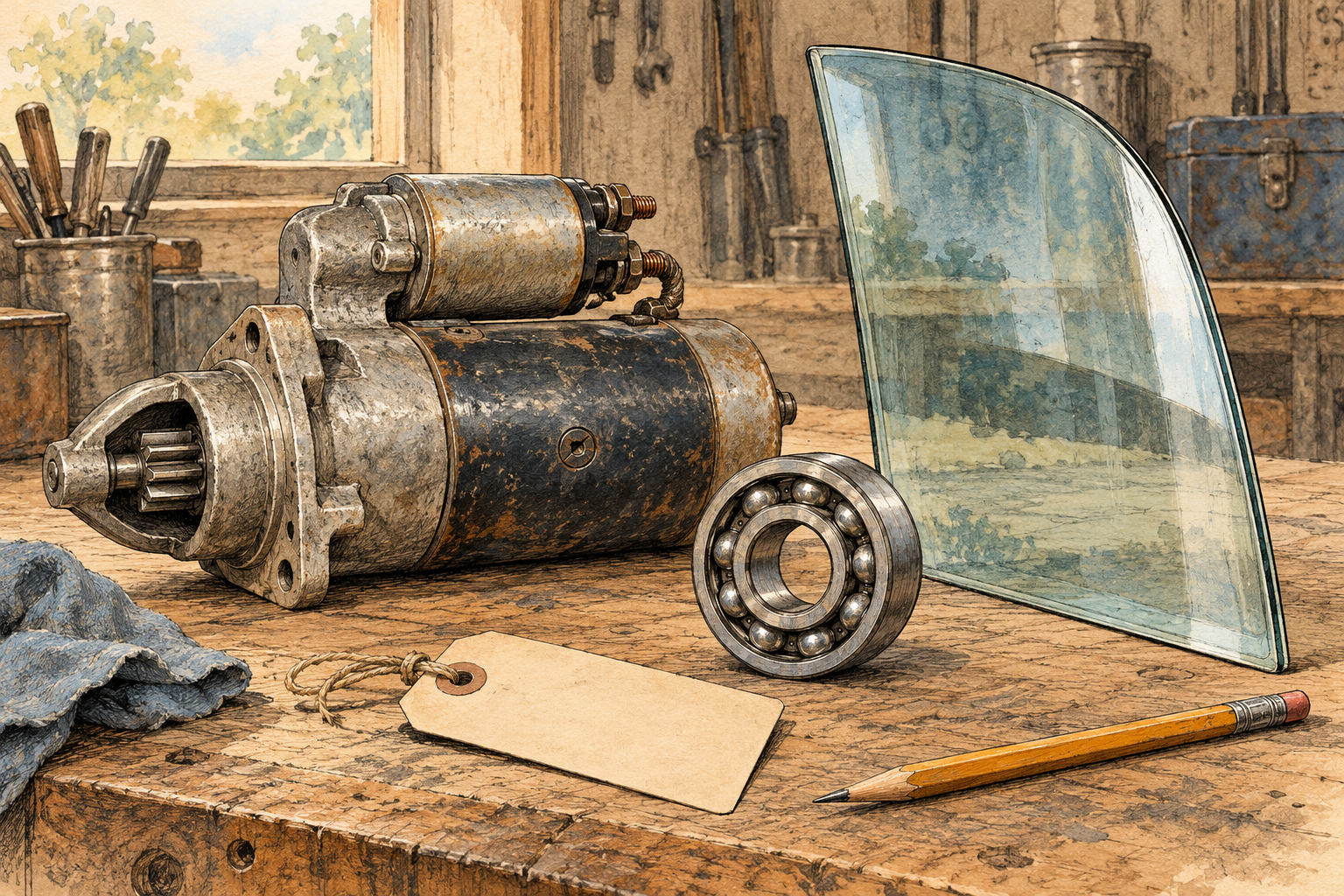
Then comes the harder question: did this particular part leave the assembly line on this truck? Three examples from our 1976 Chevrolet research show how much a good source can tell us, and where the trail still breaks.
A starter with a name
Chevrolet’s 1976 truck service supplement lists starting motor 1108778 for C & K-10 trucks with the 250 L-6, code LD4. The neighboring G-Van entry uses 1108779, so those model and engine details matter. [1]
A separate 1976 Chevelle specification sheet supplies a useful match. In its starting-motor table, the L6-250 column lists model 1108778, with Delco Remy named as the make. The sheet was issued in September 1975 for the 1976 model year; its revision field is blank. [2]
Together, the records support identifying 1108778 as a Delco Remy model in that qualified truck application. We do not have to borrow the rest of the Chevelle’s specifications to make that connection. But neither page names the factory that made an individual starter, its production date, the assembly plant that received it or the truck on which it was originally installed.
A bearing, two catalogs and a later date
Bearing number 907993 leads through two later publications. GM Catalog 51, revised in February 1983, lists it as a clutch-gear bearing assembly with a slinger. The four-speed section gives a 1973–78 application for “All, Blazer, Jimmy” with Muncie. [3]
New Departure-Hyatt’s February 1984 BB-1 catalog also lists 907993, describing 41211A packaged with a special slinger. Its number column is headed “Bearing Number,” not GM. [4]
The match connects a GM service application to an NDH product identity. Each catalog supplies a different piece: GM’s row does not name NDH or 41211A, and NDH’s row does not give the truck application. Both were published after 1976, so this is useful identification evidence without proving what went into a particular transmission when it was new.
Glass from Oshawa, but for which vehicle?
Sometimes the clue is in a newspaper rather than a parts book. On April 22, 1976, the Oshawa Times reported comments from Duplate general manager David R. Pepall. The article connected the Oshawa operation’s rear and side window glass with GM customer sites at Oshawa, Ste. Therese and Scarborough. [5]
That takes us beyond simply finding a glass company near an assembly plant. Still, the report identifies no C/K pane and does not separate truck production from car production at Oshawa. It establishes neither windshield supply nor the upstream raw-glass maker, exclusive supply, a particular shipment or installation.
Following the part all the way home
These are worthwhile finds even when they leave work to do. A maker’s name, a service application and an assembly-plant customer relationship answer different questions. Keeping them separate gives the next piece of evidence somewhere useful to fit.
A dated production bill of materials, source drawing, shipment record or original component with a well-supported history could help close a particular gap. Until then, we can say what the records support without turning a plausible connection into a claim about someone’s truck.
Sources
- 1976 Chevrolet service/overhaul supplement ST-330-76, Specifications 17 (PDF page 387), Starting Motor table.
- 1976 Chevrolet Chevelle information kit, printed page 15 (PDF page 125), Electrical—Starting System. Model year 1976; issued 9/75.
- GM Catalog 51, February 1983 revision, group 4.355, printed page 4-23 (PDF page 593), four-speed transmission section. Retained original consulted; no verified public link is available.
- New Departure-Hyatt BB-1 catalog, printed page 47 (PDF page 49), bearing 907993. The back cover (PDF page 84) gives the February 1984 date.
- Oshawa Times, “Local Parts Producer Would Like Review,” April 22, 1976, front page, archive leaf 2. Original page PDF.