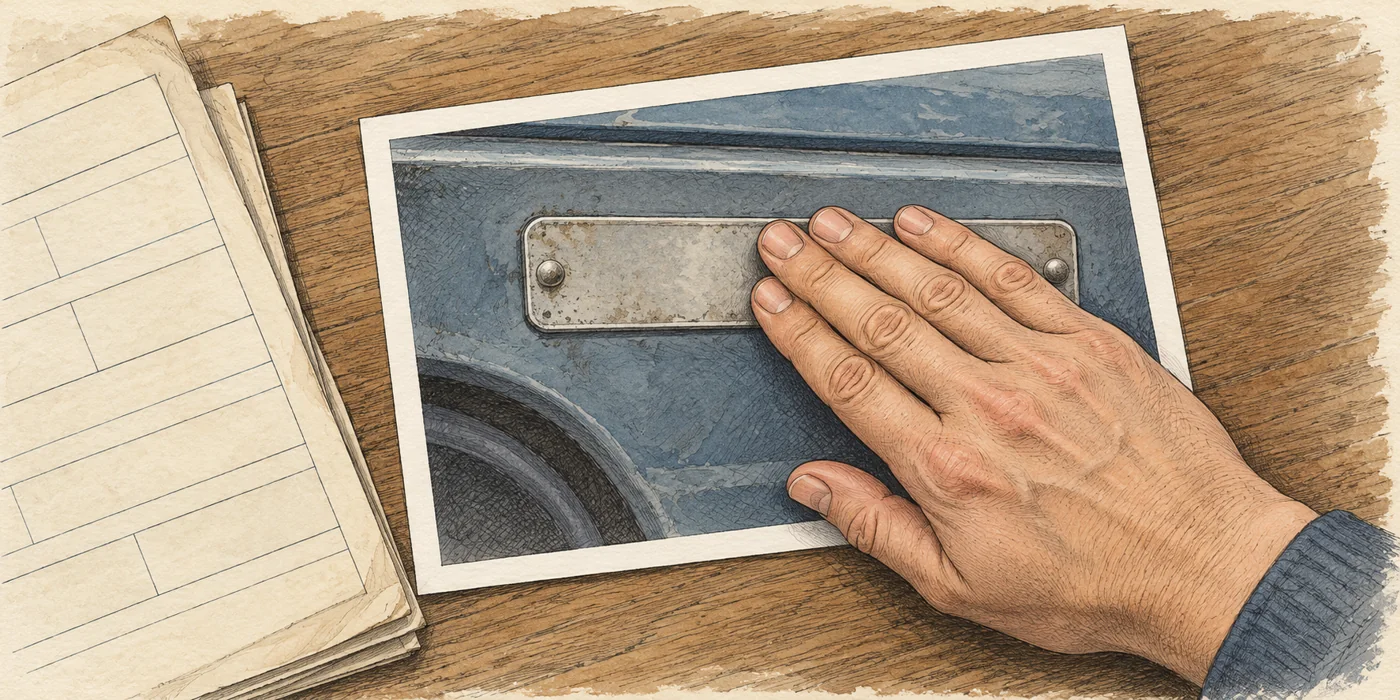
You can cover part of your VIN before posting a photo. That is your choice. A full VIN can help with truck research, but you do not have to share it to make a useful contribution.
The key is to know what a VIN can reveal, where the risks lie, and what else is in your photos. Protect personal details on old paperwork as well as deciding how much of the VIN to show.
What is a VIN?
VIN stands for Vehicle Identification Number. It identifies the vehicle. It is not a password. Knowing a VIN does not prove that someone owns the truck.
Many newer vehicles have a VIN that can be read through the windshield. Classic trucks may have their VIN plate elsewhere, such as a door pillar. Check the factory guide for your truck’s year and model.
The modern U.S. VIN format uses 17 letters and numbers. Older vehicles can have shorter VINs. For example, GM’s 1976 truck VIN guide shows a 13-character format.
A modern decoder may not work on an older truck. NHTSA’s VIN decoder is intended for model years 1981 and newer. Use a guide that matches your older truck’s year and make.
VIN cloning is a real risk
VIN cloning is fraud. A thief uses the identity of a lawful vehicle to help pass off a stolen one as legitimate. The National Insurance Crime Bureau (NICB) warns that VINs can be copied from parked vehicles.
Covering part of a VIN in an online photo limits what that photo shows. It does not make the truck theft-proof or guarantee that the full number cannot be found elsewhere. It also does not mean that posting a VIN will lead to theft. The sources here do not measure the added risk from one owner’s post.
What can someone learn from a VIN?
A VIN can give clues about the make, model year, engine, body type, and assembly plant. What it tells you depends on the year and maker. It does not list every option or prove that the truck still has its factory parts.
The VIN itself does not encode your name or home address. But a photo or sales ad can link it to personal details that you include. Think about the whole post, not just the number.
A history report may show title records, mileage readings, or reported salvage history. Its coverage has limits. The federal NMVTIS report guide warns that some damage may be missing and that reports do not replace an independent inspection. A report with no warning is not proof of a problem-free truck.
Check the paperwork before you share
An old title, invoice, or service receipt may show personal details about you or a past owner. The Federal Trade Commission advises protecting records that contain personal or financial information.
- Cover names, home addresses, phone numbers, signatures, and driver’s license numbers that do not need to be shared.
- Remove bank details, account numbers, and other private financial information.
- If you want to hide part of the VIN, check every photo and document for another copy of it.
- Edit a copy of the image. Check the saved copy before sending it, and keep the original for your own records.
These tips are about the photos you share. Leave the truck’s original tags and paperwork intact.
How VINs and labels help truck research
A full VIN can help match records to one truck and avoid counting the same truck twice. The plant and sequence codes can also help researchers compare known examples.
Those clues need care. Nearby sequence numbers alone do not prove a shared option package, an exact build date, or a total production count. Factory records and other evidence still matter.
A clear photo of an original Service Parts Identification (SPID) label can preserve the codes still visible on it. Build sheets, dealer invoices, and window stickers can add more clues.
A partial VIN or a SPID photo with part of the VIN covered can still be useful. Visible codes may help answer questions about the truck. Hidden or unreadable details should stay unknown unless the owner chooses to share more.
Share what you are comfortable sharing
If you have a Chevrolet or GMC square-body truck, your labels and old records may help preserve its history. You are welcome to cover personal details and the last VIN characters in the copies you share.
The RareTruckInfo submission form accepts a full or partial VIN. The VIN field is optional. The form does require a name and email address, so it is not an anonymous submission.
The required consent is for storage and private research review. It does not give permission to publish, display, or reuse the material commercially. Those uses need separate permission. Read the form’s current wording before you submit.
The bottom line
Protect personal details, choose how much of the VIN to show, and keep a clear copy of your truck’s records. You can help preserve its history without sharing every detail online.